Editor's Note: This article originally appeared in the January/February 2026 print edition of Produce Grower under the headline “Rethinking competition.”

CEA has always been driven by innovation. But, as the industry continues to grow, technology alone won’t carry it forward.
With rising energy costs, infrastructure challenges and increasing expectations regarding sustainability, the industry can be innovative in other ways by rethinking how to grow and collaborate.
Much of the industry has operated in silos. Technology providers guard proprietary systems. Growers compete for contracts. Energy, logistics and food production are treated as separate worlds.
Instead of struggling with that inefficient model, some CEA stakeholders are asking an important question: Where does collaboration create more value than competition?
I’m reminded of two partnership announcements in 2025: Growcer and Growtainers in the vertical farming space, as well as Nature Fresh Farms and Revol Greens in the grower space.
“Growcer and Growtainers are entering into a strategic alliance to leverage our respective strengths, learn from past mistakes and move forward in a way that we can feel good about while delivering authentic results to our customers,” Corey Ellis, Growcer CEO and cofounder, wrote in a LinkedIn post.
Partnerships across the CEA supply chain — growers, technology companies, utilities, municipalities and even adjacent industries — are providing new pathways to scale. Shared infrastructure can lower operating costs. Co-located facilities can unlock efficiencies in energy use, heat recovery and CO2 utilization. Strategic alliances allow operators to focus on core growing expertise while relying on partners for complementary capabilities.
This month’s cover story explains a feasibility study from the Resource Innovation Institute about a fascinating idea percolating in Virginia that would co-locate greenhouses and data centers, along with other complementary industrial businesses, to create what RII has dubbed a “Farm Park,” allowing industries to use a combined heat and power microgrid.
Virginia hosts the largest data center market in the world and is home to 35% of all known hyperscale data centers worldwide, according to the Virginia Economic Development Partnership. It’s a complex development plan that requires both public and private investment.
Whether you’re looking at two companies joining forces or a conglomeration of shared resources, collaboration doesn’t dilute differentiation. When growers aren’t forced to reinvent every component of their operation, they can invest more heavily in crop quality, consistency and personnel management.
This requires a mindset change, including transparency and thinking beyond short-term competitive advantages. The next chapter of CEA will likely be defined by who builds the strongest partnerships.
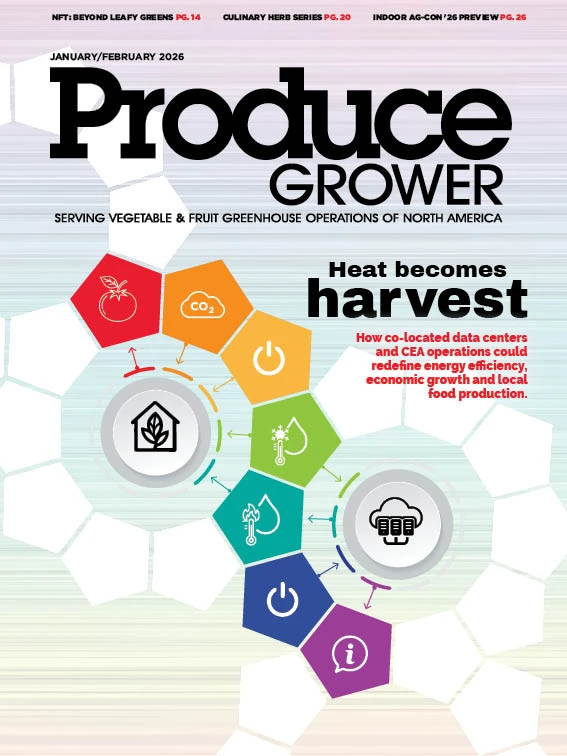
Explore the January/February 2026 Issue
Check out more from this issue and find your next story to read.
Latest from Produce Grower
- The Growth Industry podcast Episode 10: State of the Horticulture Industry
- Bimi Baby Broccoli partners with Cal-Organic Farms
- Millennium Pacific Greenhouses launches California Grown Cucumber Program
- Scientists develop vitamin A-enriched tomato to fight global deficiency
- UTIA and UT Knoxville research teams will develop automated compost monitoring system
- [WATCH] Taking root: The green industry’s guide to successful internships
- [WATCH] Advances in growing media for CEA production
- Award winners announced for 2026 PHS Philadelphia Flower Show