Update as of Friday, Dec. 19:
AeroFarms, an indoor vertical farming company and a supplier of microgreens to the U.S. retail market, announced in a Dec. 19 press release that the company is continuing to operate and supply microgreens to customers and shoppers.
"Recently, AeroFarms was provided with sudden and unexpected notice that it would not be receiving the necessary funding it required to continue operations. Since that time, the company’s circumstances have evolved rapidly. An existing stakeholder has agreed to provide funding to AeroFarms, enabling the company to continue operations and explore strategic alternatives," the company said in the updated release.
"AeroFarms is deeply grateful to its employees, partners, vendors, customers and stakeholders for their unwavering support of AeroFarms and belief in the power of its highly differentiated microgreens products. The company is committed to its mission of growing and distributing flavorful, nutrient-dense greens while supporting a resilient and sustainable food system," the company added.
Original story below:
Vertical farming company AeroFarms informed Virginia Works Department of Workforce Development and Advancement in a Dec. 11 letter that the company has “made the difficult decision to wind down all of their operations” and close its facility in Ringgold, Virginia.
The closure, announced as part of the company’s required Worker Adjustment and Retraining Notification Act (WARN) notice, includes the permanent termination of 173 employees, including remote workers, with 127 total employees being Virginia residents. The closure of facilities and permanent termination of affected employees is expected to take place on Dec. 19.
AeroFarms — a Certified B Corporation founded in 2004 — produces eight varieties of microgreens and mixes, including a rainbow mix, wasabi mustard, spicy mix, super mix, kale, broccoli, arugula and bok choy, the last of which was introduced earlier this year. The products spanned AeroFarms’ “FlavorSpectrum,” where each product coincides with a color that represents a specific flavor profile.
The company sold its products in a variety of retailers, including Whole Foods Market, H-E-B and Costco.
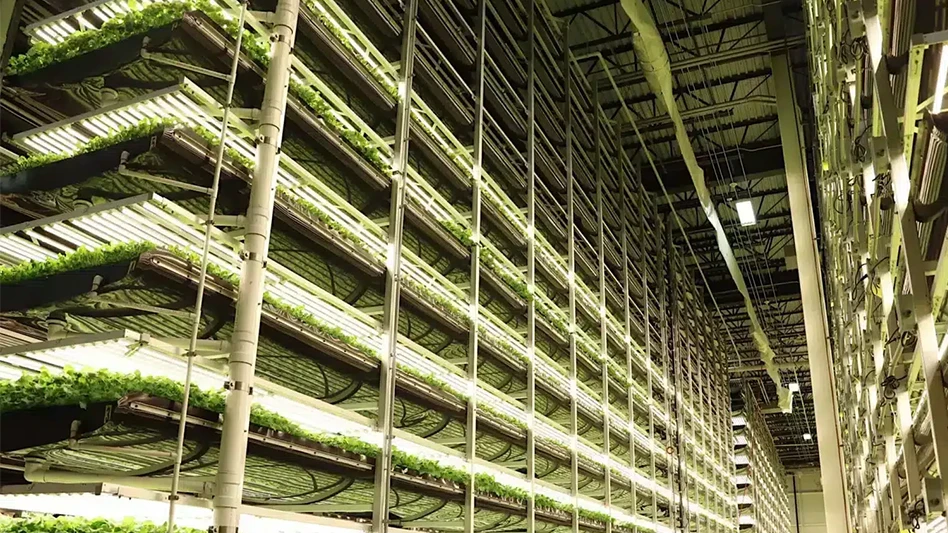
All AeroFarms microgreen varieties are grown and packaged at the company’s indoor vertical farm located in Danville, Virginia, using its patented aeroponics technology using 90% less water and 230 times less land than traditional farming and without pesticides, according to the company.
However, the company's way of operating may have been part of its downfall, according to Eric W. Stein, executive director at the Center of Excellence for Indoor Agriculture and associate professor of management science and info systems at Penn State and the Vertical Thinking columnist for Produce Grower. Stein goes on to list a lack of scalability and low profit margins as possible pain points for CEA investors.
"It doesn't always make sense to spend millions on these facilities," Stein says. "They sold microgreens — I bought theirs; they were good — but I don't think the market is there. They had national distribution, but it's not lettuce. Chefs may love microgreens; everyone eats lettuce."
He adds, "When you spend $100 million on an iPhone facility, Apple makes that amount back in days or weeks — it's a no brainer. Even for a lettuce factory, it's going to take you 10 years to make back $100 million."
The announcement follows AeroFarms filing for voluntary Chapter 11 bankruptcy protection in Delaware in 2023.
At that time, the company claimed it had struck a deal with an existing group of investors to secure debtor-in-possession financing. The deal was reportedly worth $10 million and, per that announcement, was part of a larger funding round that included those investors.
“Recently, we were informed that, contrary to the companies’ expectations, the companies’ largest investor decided to withdraw any further financial investment into AeroFarms Danville Farming Company LLC and New AeroFarms, Inc. (the two companies that make up AeroFarms), due in whole or in part to the investor’s unannounced restructuring and change in priorities,” AeroFarms Vice President of Human Resources Carlos Nunez wrote in the notice, which is addressed to a Virginia Works official.
Since AeroFarms received the notice from the investor, it worked to negotiate an extension with the investor or to secure other funding from other current investors, potential new investors and financial institutions, Nunez wrote.
The letter goes on to explain that AeroFarms believed it could obtain alternate capital sufficient to avoid or postpone closure and “reasonably believed that providing WARN notices at the time the investor communicated its decision to the companies would have precluded the companies from obtaining that capital from other sources.”
“Unfortunately, the companies’ efforts to obtain additional capital have failed and they have come to the conclusion that they cannot continue operations until they are able to obtain new funding from other sources,” Nunez wrote.
A small number of affected employees may remain for a short time to wind down the companies’ operations, but the company has not yet identified who may be asked to stay.
Nunez also wrote that “due to the unforeseen nature of the investor’s notice, and due to the immediate pursuit by the companies of alternate capital sources, the companies were not able to give affected employees any additional notice,” including the 60-day notice typically required as part of WARN notices.
Nunez said the company notified employees about the facility closure and company shutdown “as soon as possible,” electronically on Dec. 11 and by regular mail “as soon as practicable.”
Companies are permitted to give fewer than 60 days of notice “where employment loss results from ‘unforeseen business circumstances,’ such as the unanticipated cancellation of funding from the companies’ primary investor,” Nunez wrote.
Earlier this year, AeroFarms announced that it had refinanced its debt to support ongoing operations at its farm in Danville, Virginia, and had raised equity financing to further support existing operations and fund pre-construction activities for its expansion to a second farm.
“Our vision is to provide local food production of nutritious microgreens to regions around the world while preserving natural resources,” Molly Montgomery, executive chair and CEO of AeroFarms, said at the time in a news release. “We have recently demonstrated that vertical farming can indeed be sustainable, profitable and produce fresh greens at scale. I would like to extend my gratitude to our financial partners who believe in our vision and have provided financing to support our operation in Danville and commencement of pre-construction activities for expansion to a second farm.”
Equity was provided by existing investors, including Grosvenor Food & AgTech (GFA), Ingka Investments, Cibus Capital and ACEG, among others.
An asset-based loan provided by Siguler Guff was used to fully pay off the previous debt facility from Horizon Technology Finance, with additional funds to support ongoing operations at the Danville Farm. The new loan, which closed in May 2025, provided a more favorable interest rate than the previous debt, interest-only terms, and a carve-out for eligible equipment financing.
AeroFarms President and Chief Financial Officer Guy Blanchard was the keynote speaker at CEA Summit East in September 2023, where he discussed how AeroFarms was emerging stronger in the months following its Chapter 11 filing.
In his address, Blanchard said the company exited Chapter 11 bankruptcy in September 2023 and called the bankruptcy a “reorganization.”
"We are fortunate to have existing investors who continue to believe in AeroFarms and are confident that we can hit our targeted profitable operations for our Danville farm," Blanchard said at the time AeroFarms filed for Chapter 11. "There is incredible consumer and customer interest for our market-leading microgreens, and we are excited to continue be able to build our business to meet that demand."
“The business was sold to investors that were many of our previous investors, giving us an injection of capital that’s allowing us not only to continue, but grow and thrive and scale Danville and bring that to profitability,” Blanchard said in his CEA Summit East address.
“We are out of Chapter 11 today because our partners and sales, our vendors, our employees were amazing,” he continued. “No one ran from us. We had people stand by us, partner with us really across the industry. That support is what allowed us to regroup as a company very, very strong and be positioned for this profitable success in the future.”
In his address, Blanchard said AeroFarms would hit full production capacity at its Danville farm in 2024, with goals of making its microgreens production profitable. He also said the company had seven SKUs in more than 2,000 stores nationwide.
Latest from Produce Grower
- 3 takeaways from Indoor Ag-Con’s ‘The State of CEA Finance’ keynote panel
- Red Sun Farms, Heritable Agriculture and CIV partner on indoor strawberry innovation
- Rethinking a leafy legacy
- The Growth Industry Episode 9: IPPS International Tour preview with Brie Arthur and Liz Erickson
- 4 key takeaways from the Indoor Ag-Con 2026 keynote panel
- Indoor Ag-Con 2026 guide
- Mondi Products launches Avara Technology
- IUNU and Priva partner on yield forecasting for greenhouse growers