Editor's Note: This article originally appeared in the July/August 2025 print edition of Produce Grower under the headline “How can CEA operations prepare for AI & advanced robotics?.”

CEA AI & Robotics Primer
This is the second in a multipart series on advanced robotics in CEA, which includes excerpts from the Resource Innovation Institute’s AI & Robotics Primer.
RII is a not-for-profit organization dedicated to advancing resource efficiency across controlled environment agriculture through data-driven insights, best practices and industry collaboration.
The AI & Robotics Primer was developed under RII’s CEA Accelerator Project, a national initiative funded by the U.S. Department of Energy and hosted in partnership with the Lawrence Berkeley National Laboratory.
The guide reflects contributions from a broad coalition of growers, equipment manufacturers, automation and robotics providers, academic researchers and government leaders working together to address the evolving needs of the CEA industry. It is a free resource to be shared with the CEA industry to understand how emerging technologies could impact controlled growing.
Read the first article in the series here: bit.ly/ai-robotics-part1
Cost considerations for advanced robotics
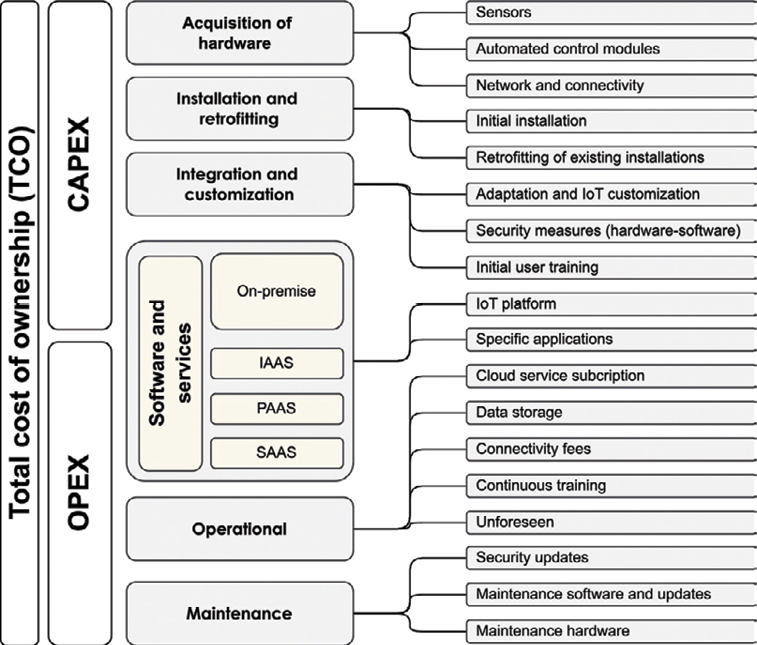
Robotics typically cost more than other forms of AI, and their implementation will require careful analysis of costs and potential returns. Their deployment encompasses a wide range of specialized machines designed for specific tasks, from $30,000 for autonomous pot-spacing robots up to hundreds of thousands of dollars for the most advanced harvesting and grading systems.
A 2022 analysis, “Use of Robots and Artificial Intelligence in Greenhouse Horticulture,” from Rabobank states that while initial investment costs can be significant, economic viability is possible. Here are some examples of the report’s findings, although prices may have shifted in the three years since the study was published:
- Leaf pruners: These specialized robots typically cost between $175,670 to $585,570*. The potential labor savings of $175,500 to $292,800 per hectare for high-tech greenhouses suggest viability.
- AGVs: These systems typically cost $117,000 to $175,500 and can often achieve payback within two years through labor savings and reduced product damage.
- Harvesters: These systems typically cost $117,000 to $585,570 and can often achieve payback within two years through labor savings and reduced product damage.
*Note: All figures were originally reported in euros and have been converted to U.S. dollars using the most recent conversion rates.
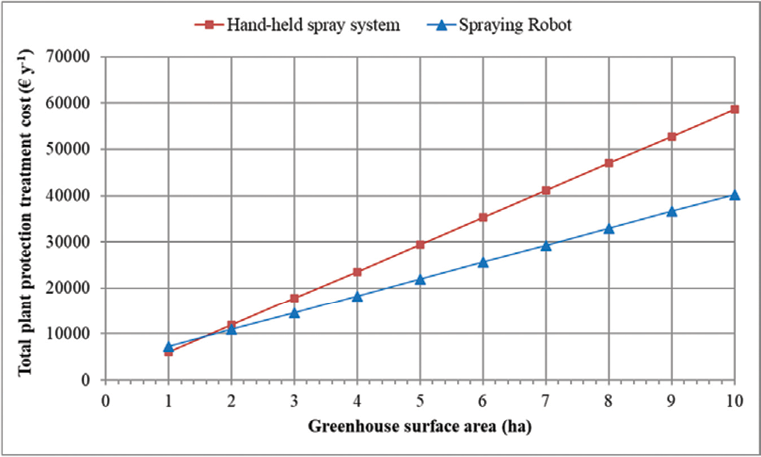
A detailed economic model from 2024 published in Smart Agricultural Technology provided mixed results, at least based on outright purchase of the robots. It modeled robotic sprayers, costing $41,000, and robotics harvesters, costing $58,500, in Mediterranean-style greenhouses located in southeast Spain.
For the sprayer, the authors assumed it would be used 30 times per year. For the harvester, they assumed a harvest efficiency of 66% and a processing time of 33 seconds per fruit. (Note: This 2012 baseline has advanced considerably during the past 13 years, with the AI & Advanced Robotics Working Group documenting systems operating at less than 1 second per fruit.)
Figure 2 shows that, after all costs are factored in, the annual cost of pest treatment is less for the robot than the hand sprayer for greenhouses greater than 1.5 hectare (3.7 acres). The authors also determined that shared use by leasing would reduce costs by a further 35%, making it economically viable for even smaller growers.
However, it was determined that due to speed, four robotic harvesters operating 24 hours a day would be needed per hectare of greenhouse to keep up with the tomato harvest demand. This caused the annual cost of harvesting with the robot to be 18 times higher than manual harvesting, rendering it economically nonviable.
Of course, with some modern harvesting systems achieving speeds 33 times faster than those in 2012, according to findings from the working group, viability is much more likely now. Additionally, operations will be able to rent or subscribe to robotics services rather than purchase them, just as small- to mid-size field farmers rent combine harvesters today. Below are some of the alternate business models:
- Robotics-as-a-Service (RaaS): This model offers robotics capabilities on a subscription basis, allowing companies to access and use robots without the high upfront costs of purchasing them. Payments are typically tied to usage, such as hourly operation, acres covered or tasks completed.
- Subscription services for AI software: Companies provide AI-powered analytics and predictive tools through cloud-based subscriptions. This ensures growers or businesses always have access to the latest algorithms, software updates and support without requiring major investments in in-house technology.
- Leasing models for hardware: In this model, companies lease AI-enabled robotics systems or IoT hardware, spreading the costs over time and enabling businesses to adopt advanced technologies without committing to full ownership.
- Pay-per-use (PPU) or outcome-based pricing: Businesses pay only for the results generated by the robots or AI, such as kilograms of produce harvested or reduction in energy use, incentivizing performance-based technology deployment.
- Integrated service models: Some companies bundle AI and robotics into a comprehensive package, including sensors, software, hardware and maintenance services. This “full-stack” model simplifies adoption by handling all integration and support components.
- Data monetization models: In industries like agriculture, companies offer discounts or reduced costs for robotic systems in exchange for access to collected operational data, which can then be anonymized and monetized.
Which tasks should be prioritized?
After initial conversations, form an implementation team by identifying interested employees who will most likely be working with the new technology. Building trust and a sense of ownership with employees is paramount. Identify a lead for this team and identify business goals, then bring in outside experts.
Operations just getting started in automation should start at the beginning and end of production and work their way to the middle: Mechanizing the pot filling, seeding and transplanting, as well as the sorting and packaging of the final product, can yield proven gains, while cultivation tasks are the most difficult and need further study.
For robotizing cultivation, operations should begin by analyzing which tasks are most suitable for early robotization through a systems analysis of their processes, as in Figure 3. Research and implementation experience suggest starting with tasks that are repetitive, standardized and do not require complex manipulation. Crop monitoring, scouting and data collection tasks can be automated with relatively low risk and provide immediate benefits. Environmental control optimization through AI-enhanced climate management represents another early opportunity, as it builds upon existing systems.
Simple maintenance tasks like leaf removal and basic plant care, along with sorting and grading harvested produce, represent the next tier of automation opportunities. More complex tasks like harvesting require sophisticated robotics and should generally be considered secondary priorities once simpler applications prove successful. The key is finding the right technology and supplier.

What facility design considerations are there for AI & advanced robotics?
The most automated facilities will need robust Wi-Fi coverage in main aisles with dead-spot minimization and wired connections for critical systems and high-bandwidth applications. Before adopting, check current Wi-Fi strength and document what types of devices are already using it. IoT technology will need reliable cloud connections and backup systems.
For navigation of AGVs or robots, induction lines may need to be embedded in the aisle floors and light detection and ranging (lidar) systems or RFID beacons installed. Network segmentation for security and performance, along with adequate bandwidth for sensor data and robot communications, are essential elements of the basic infrastructure.
Physical space requirements must also be carefully planned. Clear robot travel paths with appropriate width and surface quality are essential, as are dedicated areas for robot storage, charging and maintenance. Operations should work toward standardized growing system configurations where possible. Safety barriers may be needed in some areas, and careful planning of sensor mounting locations and cable routing paths will ensure reliable system operation.

What can be done now for data preparation and planning?
During initial meetings with AI and robotics vendors, growers should ask what data preparation is needed for smooth implementation. This will be unique to each facility. Standardized data collection procedures may need to be established, along with proper sensor calibration, maintenance and validation protocols. Some might find it helpful to document growing protocols and decision-making processes. This foundational work ensures that when AI systems are implemented, they will have access to high-quality historical data for training and optimization.
The increased connectivity and automation in CEA operations introduce new cybersecurity considerations. Recent incidents, including a notable case where hackers accessed a facility’s systems through an unsecured sensor network, highlight the importance of comprehensive security planning. The “attack surface” expands significantly as facilities add connected sensors, automated systems and robotic platforms.
Employee training becomes a critical component of security planning, as human error often presents the greatest security risk. Regular security audits and incident response planning should become standard practice, supported by relationships with cybersecurity experts who understand the unique requirements of agricultural automation.

Explore the July/August 2025 Issue
Check out more from this issue and find your next story to read.
Latest from Produce Grower
- OHP expands sales team with new hire and internal promotion
- New internship data empowers horticulture employers
- Resource Innovation Institute and The Ohio State University launch first national CEA training certificate for design and construction professionals
- Farm Bill passes out of House Committee on Agriculture
- Gotham Greens celebrates 15-year anniversary in CEA industry
- [WATCH] Taking root: The green industry’s guide to successful internships
- The Growth Industry podcast Episode 10: State of the Horticulture Industry
- BM2 Automation