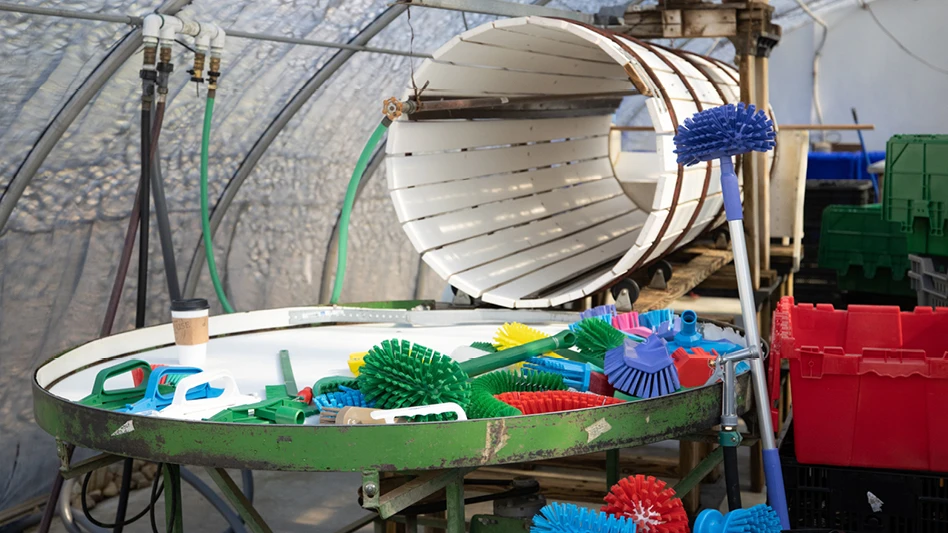
Photo courtesy of Andre Chamberlin, The University of Vermont Extension
Editor's Note: This article originally appeared in the November/December 2025 print edition of Produce Grower under the headline “Food safety regulations.”
As part of the Controlled Environment Agriculture Herb Extension and Research Base project, our research team at Texas Tech University has been focusing on advancing food safety practices in controlled environment agriculture. This article highlights the newest U.S. Food and Drug Administration food safety regulations and outlines best practices to support a robust foodborne illness prevention strategy for CEA herb growers.
The law: FDA Food Safety Modernization Act Produce Safety Rule
The FDA’s Produce Safety Rule, enacted under the Food Safety Modernization Act, establishes science-based minimum standards for the safe growing, harvesting, packing and holding of fruits and vegetables intended for human consumption. Its primary goal is to prevent microbial contamination and reduce foodborne illnesses associated with produce, especially those commonly consumed raw.
While some exemptions apply based on average produce or food sales, direct-to-consumer sales or further processing of produce, all producers should consult Title 21, Code of Federal Regulations, Part 112 for full details.
The rule consists of subparts that provide guidance in the following areas: general provisions and requirements (Subparts A and B); personnel qualifications and training (Subpart C); health and hygiene (Subparts D); agricultural water (Subpart E); biological soil amendments of animal origin and human waste (Subpart F); domesticated wild animals (Subpart I); growing, harvesting, packing or holding activities (Subpart K); equipment, tools, buildings and sanitation (Subpart L); sprouts (Subpart M); analytical methods (Subpart N); records and variances (Subparts O and P); and compliance and enforcement strategy and withdrawal of qualified exemptions (Subparts Q and R).
To support industry compliance, the FDA has developed a series of accessible fact sheets. Most fresh-cut and potted herbs fall under this rule unless they are processed in a way that kills pathogens (e.g., cooked or dried).
What’s new: Pre-Harvest Agricultural Water final rule
The final rule on FSMA PSR Pre-Harvest Agricultural Water (Subpart E) introduces a systems-based assessment approach that replaces previous microbial testing criteria. “Pre-harvest agricultural water” refers to water used during growing activities, such as for irrigation and crop protection sprays that touch the edible portion of the crop.
For herb growers, the likelihood of the water touching the edible portion of the herb is high due to watering practices such as hydroponics systems; therefore, it is considered agricultural water (Figures 1 and 2). The agricultural water assessment must evaluate the following factors:
- Agricultural water system(s): The location and nature of the water source, water distribution system and degree the system is protected from contamination.
- Agricultural water practices: The type of water application method and the time interval between the last direct application of the agricultural water and the harvest time of the covered produce.
- Crop characteristics: Is the surface of the herb susceptible to adhesion or internalization of the food safety hazard?
- Environmental conditions: Frequency of exposure to weather events, air temperatures, sun (UV radiation) exposure or events that can stir sediments that contain human pathogens.
- Other relevant factors that may increase the food safety risk of the agricultural water used.
This tailored approach allows each grower to assess how their agricultural water may impact the safety of their specific crops. It offers flexibility, recognizing that farms and growing conditions vary widely.


What else is new: FSMA Traceability Rule (FSMA Section 204)
The FDA Food Traceability Rule, finalized in November 2022 under the Food Safety Modernization Act, requires additional record-keeping for certain foods to enhance traceability and facilitate the faster identification and removal of potentially contaminated food from the market.
The rule applies to firms that manufacture, process, pack or hold foods listed on the Food Traceability List, which includes many fresh herbs, with the exception of those listed in 21 CFR 112.2(a)(1) (rarely consumed raw), particularly dill. These firms must maintain records of Key Data Elements associated with Critical Tracking Events, such as harvesting, cooling, packing and shipping. Upon request, all required records must be provided to the FDA within 24 hours. Although the original compliance deadline was Jan. 20, 2026, it has been extended to July 2028 in response to industry concerns about readiness and implementation challenges.
Best practices for CEA herb growers
To help herb growers reduce food safety risks, here are four key recommendations based on current food safety research:
1. Understand the food safety history of your herb crop
Perform thorough literature and online searches to identify whether your herb crop has a history of foodborne outbreaks or recalls. For example, basil has been linked to multiple salmonella outbreaks. Understanding historical data can help you develop a targeted risk assessment specific to your crop. Consider adjacent herbs when evaluating overall food safety risk.

2. Conduct a comprehensive input risk assessment
All inputs, including agricultural water, seeds, substrates, containers, equipment and tools, can introduce food safety risks. To determine the food safety risk, start with your input suppliers. Certificates of analysis — which verify the quality, safety and authenticity of a food product by providing evidence that it meets specific quality and safety standards — can be valuable during this risk assessment, but growers should verify the production and handling practices; sensitivity and specificity of microbial tests; frequency of microbial testing; and whether CoA standards match your herbs’ food safety risk. Asking critical questions about the origin and handling of each input helps strengthen your food safety risk management.
The next step is to determine your handling and holding practices of these inputs. Is there a possibility that your storage areas can introduce food safety risks (birds, rodents, condensation)? Understanding the role of your facility in the food safety risk can assist with this comprehensive input assessment.
3. Review and update cleaning and sanitation protocols
- Reusable tools, bins, benches and conveyor belts are essential in herb production, but they can also serve as persistent sources of microbial contamination if not thoroughly cleaned and sanitized. Cleaning and sanitization programs should be based on your specific tools, equipment and facility design. Effective sanitary and hygienic design includes: Visible and reachable surfaces: How easy is it for your cleaning crew to determine if the equipment or piping is visibly clean? Design for disassembly where needed (modular trays, removable benches).
- Smooth and cleanable materials: Does the material have seams, grooves or textures that require special brushes to clean? Use non-porous materials (e.g., stainless steel, food-grade plastics) that are easy to clean. Special brushes or foamers may be needed for textured surfaces; these tools should be readily available and stored in a hygienic manner (Figure 3).
- Absence of collection points: Does tubing between the holding tank and the growing units have any sediment and debris collection areas? Inspect all hoses, tubing, drains and joints to ensure water flows freely and does not stagnate. Implement routine flushing protocols.
- Use of compatible materials: Can your PVC pipes and equipment surfaces withstand daily sanitizer treatments?
- Contamination prevention strategies: During harvest, are there scenarios where cross-contamination can occur? Does your workflow or facility design increase the chance of contamination during harvest or handling? Monitor high-risk areas such as ceilings, drains, HVAC units and condensation-prone surfaces, which may harbor Listeria monocytogenes.
Conduct routine environmental sampling. Establish clear separation between clean and dirty zones and between growing and postharvest areas.
Establish a “sanitary clean break”— a planned, documented and verified break in production to thoroughly clean and sanitize food contact surfaces. Schedule clean breaks between production batches and validate effectiveness through microbial swabbing or visual inspection.
If your operation was implicated in a food safety recall or outbreak, you will need to establish when your last sanitary clean break was and what method was used during that process. This is essential for identifying the last point of contamination control in case of a food safety incident.

4. Enforce worker hygiene protocols and implement role-based food safety training
Workers are one of the primary sources of human pathogen transmission in herb production, particularly during planting, harvesting and postharvest handling. In high-density growing environments such as greenhouses, the risk of contamination is amplified due to frequent human contact and the potential for cross-contamination between surfaces, tools and plant materials.
Everyone in your facility needs food safety training. Have you reflected on every task or duty within your facility and how employees can identify and eliminate a food safety risk?
For example, do your maintenance workers know that welding a leaky holding tank can create a niche area for biofilm formation? Or does your procurement development know what specific foodborne bacteria testing should be completed on your seeds prior to ordering? Do you have simple and easy-to-follow guidelines to ensure worker hygiene, such as signage and reminders in high-risk areas (e.g., handwashing stations, Figure 4)? How often do you provide refresher training?
Create a culture where all staff can identify and mitigate food risks based on their daily tasks and know when to ask management questions.
The plan ahead
Your food safety strategy should align with your operation’s integrated pest management system and core values. Through education, monitoring and thoughtful control of every input and process, herb growers in CEA systems can significantly reduce the risk of foodborne illness and contribute to a safer food supply.
Explore the November/December 2025 Issue
Check out more from this issue and find your next story to read.
Latest from Produce Grower
- [WATCH] Advances in growing media for CEA production
- Award winners announced for 2026 PHS Philadelphia Flower Show
- U.S. horticulture operations report $18.3 billion in sales: USDA
- Industry leaders call for action to support economic aid for specialty crops
- Sollum Technologies launches SF-INFINITE, a new LED fixture for commercial greenhouses
- [WATCH] Taking root: The green industry’s guide to successful internships
- ACT announces 2026 event series focused on resilience, energy, efficiency in greenhouse growing
- BioWorks appoints Chris Rose interim general manager