Editor's Note: This article originally appeared in the May/June 2025 print edition of Produce Grower under the headline “Retrofit & refresh.”

When new construction isn’t in the cards, retrofits and upgrades can help solve some inefficiencies. But there are some pitfalls to avoid to help the process work best for your situation.
Whether it’s budgetary reasons, season timing or lack of available construction materials, opting for greenhouse retrofits over new construction has been the best use of funds and time for some growers. Retrofit projects provide some relief to certain production pain points, says Duane Van Alstine, customer solutions rep at GGS Structures in Vineland Station, Ontario, Canada.
“Look for ways that upgrades and retrofits can improve your efficiencies,” he says.
Because labor is typically a grower’s biggest expense, finding ways for crews to be more efficient typically provides a good return on investment.
“Consider using rolling benches instead of stationary ones,” he advises.
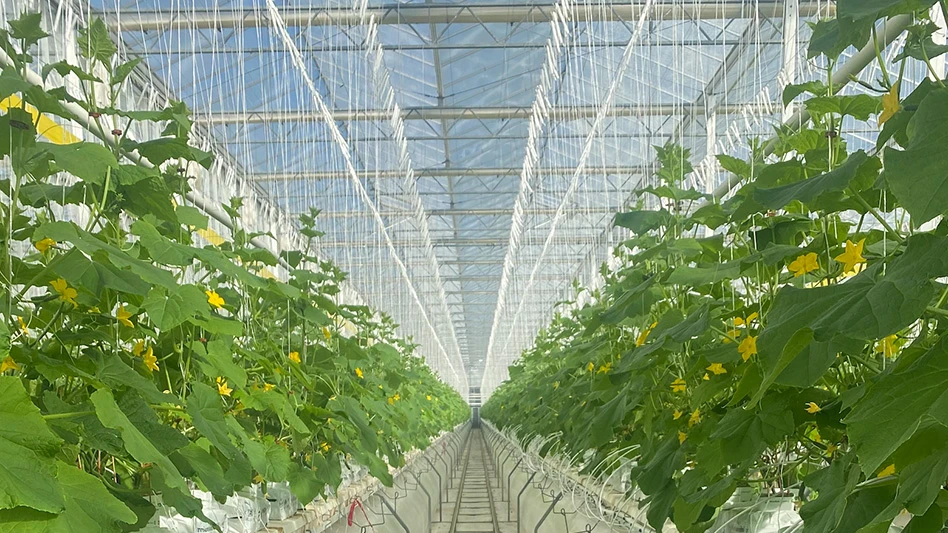
In a range with rolling benches, there is only one aisle per house, which increases production space and helps workers move around the greenhouse more efficiently for chores such as scouting, pruning or harvesting.
“These are things that will save you tons of time and make your workers’ jobs a lot easier,” Van Alstine adds.
Wage increases cut into margins, so making efficiency improvements will pay off.
He recalls when he was a grower in a 10-acre greenhouse several years ago. “We bought a tagging and labeling machine that we’d been putting off, but it paid for itself in only two weeks.”
Van Alstine also suggests improving material handling with things like double rail carts or conveyor belts.But bring in an expert to make sure your current greenhouse design is capable of handling these types of upgrades. It’s not a simple plug-and-play situation.
“What’s the current condition of your greenhouse? Are you able to make these improvements based on the age and condition of your space? These are critical questions to ask,” he adds.
If you purchased an existing greenhouse and the former owner isn’t around to answer questions, it’s best if you have the original drawings, Van Alstine says.
Consider the age of your glazing and inspect it to see if it’s hindering light transmission. The age of your curtains could also be affecting production. These types of upgrades will improve the health of the crop until it’s possible to build a new greenhouse range.

Retrofitting lighting conditions is a common project, but it’s one that requires outside help, he adds.
To combat the increase in operating costs, check your vents. Inspect the rubber seal on ventilation windows. Improper seals cost money, as heat is directed out of your greenhouse, he explains.
When the market conditions call for an increase in production, retrofits may be the best option when a large construction project isn’t feasible, he says.
“When there’s a shortage in market, they may need to change a zone or two to react to the market, like adding tomatoes when you’ve been growing lettuce,” he explains. “But what sounds like a simple changeover could be much more complicated because of the different growing conditions needed. Sometimes combining systems and combing equipment won’t work the way a grower hoped it would work.”

A.J. Both, controlled environment extension specialist at Rutgers, acknowledges some of the benefits of retrofitting a greenhouse.
“Utilities are already in place and may not need to be upgraded. And it could be easier and quicker to secure permits,” Both says. “And greenhouse workers are already familiar with the layout and operation of the facility.”
Both offers some advice on mistakes to avoid.
“Unless it’s an emergency, one of the biggest mistakes is not putting enough thought into what strategy is best for the business long-term. In addition, not considering the decision as an opportunity to make operational improvements,” Both explains. “Another common mistake is not previously having considered the question: What would we change if...? Or not having a plan in place that would allow you to consider the financial consequences.”
Sometimes a change in policy requires a retrofit.
“Currently in Canada, there’s a push to require that none of your roof water can go into your pond, and there’s talk of requiring growers to add liners to ponds,” he says.

Explore the May/June 2025 Issue
Check out more from this issue and find your next story to read.
Latest from Produce Grower
- OHP expands sales team with new hire and internal promotion
- New internship data empowers horticulture employers
- Resource Innovation Institute and The Ohio State University launch first national CEA training certificate for design and construction professionals
- Farm Bill passes out of House Committee on Agriculture
- Gotham Greens celebrates 15-year anniversary in CEA industry
- [WATCH] Taking root: The green industry’s guide to successful internships
- The Growth Industry podcast Episode 10: State of the Horticulture Industry
- BM2 Automation