Editor's Note: This article originally appeared in the September/October 2025 print edition of Produce Grower under the headline “pH optima.”

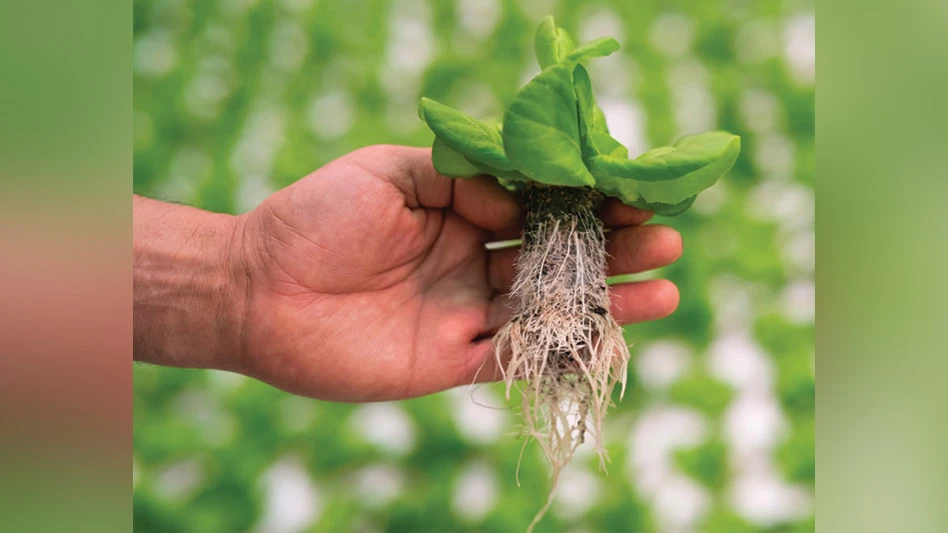
Edible leafy crops such as lettuce and herbs are most commonly grown in water culture-based hydroponic systems featuring recirculating nutrient solutions, such as nutrient film technique (NFT) systems and deep water culture (DWC). In these systems, the electrical conductivity (EC) and pH are managed to maximize yields and maintain marketable appearances.
Previous work at Iowa State University has produced research-based guidelines for managing the EC for culinary herbs growing in recirculating water culture. However, there has been no systematic research performed with commercially important culinary herbs across a range of nutrient solution pHs to characterize the responses of these crops to pH and determine target pH values for managing pH in production.
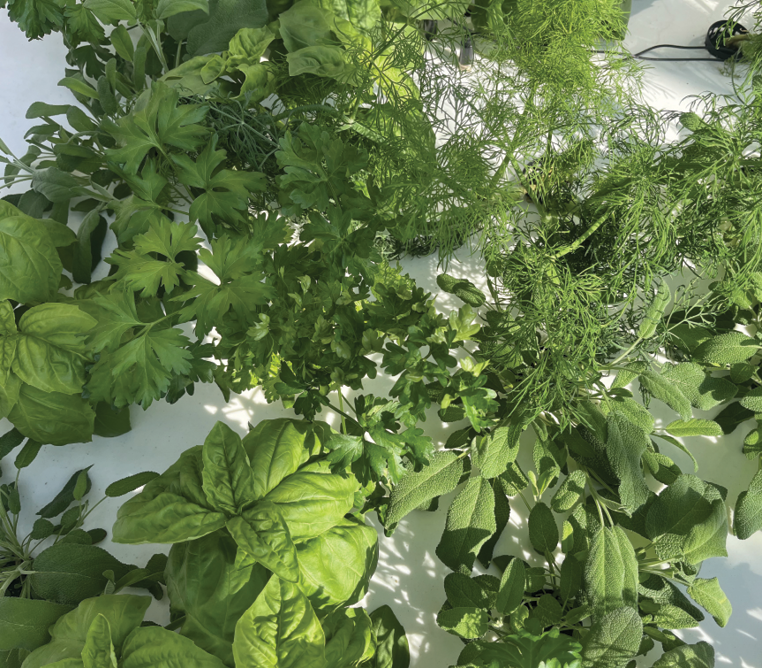
We designed an experiment to determine how the pH of nutrient solutions affects plant growth and tissue nutrient concentrations for basil, dill, parsley and sage grown in hydroponic water culture systems. By growing these herbs across a range of pH levels from 4.5 to 7.0, our goal was to identify the effects of pH on yield and foliage appearance to determine pH optima and acceptable ranges for herb production in multi-species culture.
What we did
Seeds of basil ‘Nufar’, parsley ‘Giant of Italy’, dill ‘Hera’ and sage were sown in 162-cell phenolic foam propagation cells (Oasis Horticubes XL Multi Seed Top Groove; Smithers-Oasis), with five seeds per cell. Seedlings were grown in an environmental growth chamber with a 73 °F constant temperature and a 16-hour photoperiod with a 75 µmol·m–2·s–1 light intensity.
At each irrigation, seedlings were irrigated with tap water amended with 100 ppm N from a balanced, water-soluble fertilizer (Jack’s 16-4-17 Hydroponic; JR Peters). Seedlings were thinned to three seedlings per cell prior to transplant into hydroponic systems.
Two (basil) or three weeks (dill, parsley and sage) after sowing, seedlings were transplanted into one of six DWC hydroponic systems (Premium White 3’ × 6’ ID Tray; Botanicare). Each DWC system was filled with ~66 gallons of nutrient solution with an electrical conductivity (EC) of 2.0 mS·cm–1 comprised of clear municipal water and the same fertilizer (Jack’s 16-4-17 Hydroponic) used in propagation.
Each system was initially adjusted to one of six different pHs — 4.5, 5.0, 5.5, 6.0, 6.5 and 7.0 — and constantly maintained at these levels using automated dosers with peristaltic pumps (pH Mini Controller; Autogrow). The pumps delivered either acid (2% sulfuric acid) or alkali (2% potassium hydroxide) as pH increased above or decreased below, respectively, target nutrient solution pH values. Plants were grown at day and night air temperatures of 72 °F and 64 °F, a 16-hour photoperiod and a daily light integral of 12 mol·m–2·d–1.
Four weeks after plants were transplanted into pH treatments, plants were harvested and data were collected on chlorophyll concentration, height and width, chlorophyll content, fresh and dry shoot weight, and system pH and electrical conductivity (EC). Shoot tissues were analyzed for mineral nutrient concentrations.
What we found
The greenness, or relative chlorophyll concentration, of the oldest, middle-aged and youngest leaves were unaffected by pH for all four species in our study. With respect to plant growth and development, the height, width and fresh and dry mass of shoots was unaffected for basil, parsley and sage, though dill yield was greatest at 5.5, and sage width was greatest at 7.0.
For all four species, roots were shorter at low (4.5) and high (7.0) pHs compared to moderate (5.0 to 6.0) pHs. The ratio of root fresh weight to shoot fresh weight was lowest at 5.5 for basil, dill and parsley, indicating more allocation of growth into shoots at that pH.
In addition to the growth and development of herbs, we also quantified the concentration of mineral nutrients in the shoots of the plants in our study. In hydroponic culture, nutrient availability can shift as pH changes. Most notably, as pH increases, micronutrient availability decreases, which can cause deficiency symptoms, which may reduce or eliminate marketability of shoots.
To determine the adequacy of tissue nutrient concentrations for basil, parsley and sage, we used the sufficiency ranges recently developed at North Carolina State University as part of our CEA HERB project, while for dill we used the most relevant guidelines previously developed from field production.
For basil, parsley and sage, we did not find any nutrients that were deficient. Although Ca was deficient in dill tissue across all pH treatments, the reference target ranges used were developed from field-grown plants. There were no symptoms of nutrient deficiencies for any plants, nor were there lower chlorophyll concentrations in any of the pH treatments in lower, middle or upper leaves. While some micronutrient concentrations were considered excessive at low pH levels (i.e., manganese for parsley and sage) or across most pH levels (molybdenum for basil, parsley and sage), we saw no symptoms of micronutrient toxicity on any foliage for any of the species in the study.

What it means
The primary goal of this study was to determine the optimal pH for basil, dill, parsley and sage, as well as more broad pH ranges sufficient for commercial hydroponic herb production. The primary determinant we used for optimal pH was shoot fresh weight, as for fresh-cut herbs, this is the commercial yield.
For basil, dill and parsley, we determined 5.5 is the optimal pH. While sharing similar optima, the suitable range of nutrient solution pH is broader for basil (4.5 to 6.5) than that of 5.0 to 6.0 for dill and parsley. Of the four species, sage is unique in growing best with an elevated pH, with an optimal pH of 6.0 and suitable range of 5.5 to 6.5. When we compare the suggested pH ranges based on our study to the pH ranges recommended by Lynette Morgan in the book “Fresh Culinary Herb Production,” our findings expand the suggested ranges for basil and parsley while providing new ranges for dill and sage.
In controlled environments, fruiting vine crops (including tomato, pepper and cucumber; small fruits such as strawberry; and leafy crops like lettuce) are primarily produced as monocultures of a single species. However, culinary herbs are unique among food crops produced in controlled environments, as they are almost always grown in polycultures including numerous species. When determining at what pH the nutrient solution shared by all species should be maintained, the recommended pH ranges of each species should be taken into consideration. However, multiple factors may influence the pH selected. The relative proportion, based on growing area, of each species should be accounted for. For example, basil and sage have pH optima of 5.5 and 6.0, respectively. Since basil will likely occupy a much larger area than sage due to its popularity, the pH may be managed closer to 5.5 for basil than to 6.0 for sage.
Another factor to consider is nutrient solution replacement. In our study, we replaced approximately one-third of the volume of the nutrient solution each week to avoid nutrient imbalances across the different pH treatments. Replacing nutrient solution in recirculating water culture systems is a common practice for commercial producers.
However, the frequency and volume of nutrient solution replaced in recirculating water-culture systems will vary widely among producers. For those producers who are replacing moderate volumes of solution fairly frequently, their results would be comparable to ours in this study.
However, for those producers exchanging a smaller volume of solution and/or on a less-frequent basis, we suspect growth suppression at elevated pH levels (i.e., >6.0 or 6.5) will suppress growth and yields of basil, parsley and dill while also limiting micronutrient availability and tissue concentrations, potentially resulting in micronutrient deficiency-induced chlorosis of the newest leaves.
The take-home message
Providing sufficient mineral nutrients and maintaining their availability in recirculating nutrient solutions provided to culinary herbs is essential for maximizing yields and maintaining quality. The results of our study give research-based pH optima and ranges for some of the most important culinary herbs grown in controlled environments: basil, dill, parsley and sage. While more research is needed to determine the pH requirements of other herb species, our results can be used with confidence for commercial production and additional trials.

Explore the September/October 2025 Issue
Check out more from this issue and find your next story to read.
Latest from Produce Grower
- OHP expands sales team with new hire and internal promotion
- New internship data empowers horticulture employers
- Resource Innovation Institute and The Ohio State University launch first national CEA training certificate for design and construction professionals
- Farm Bill passes out of House Committee on Agriculture
- Gotham Greens celebrates 15-year anniversary in CEA industry
- [WATCH] Taking root: The green industry’s guide to successful internships
- The Growth Industry podcast Episode 10: State of the Horticulture Industry
- BM2 Automation