Photo © Anthony Elder
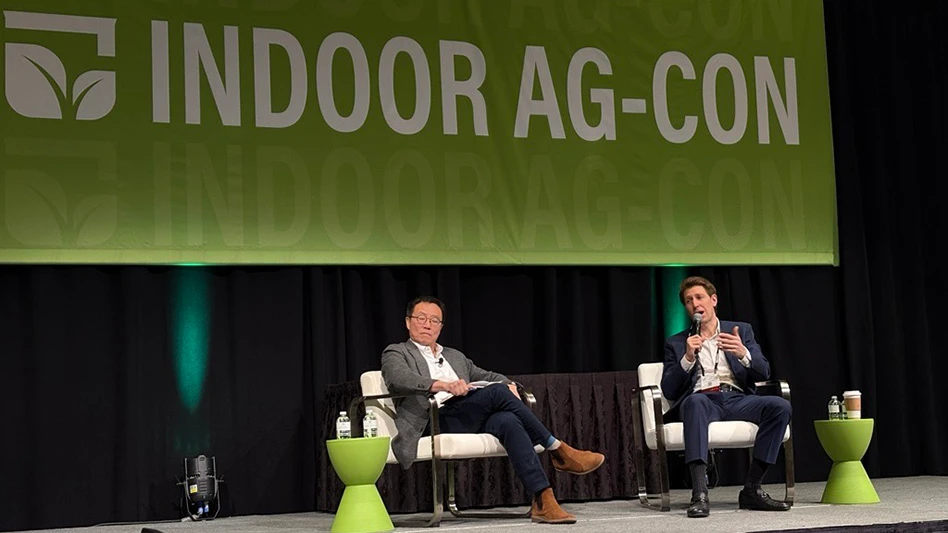
Day two of Indoor Ag-Con 2026 kicked off with another positive yet critical panel from Dave Chen, CEO of asset management firm Equilibrium, and David Verbitsky, president of Verbitsky Capital.
Interviewing each other, the two looked back on what they called “mismatched” investment partnerships that have plagued the CEA industry since its inception. Following suit with the previous day's State of the Industry keynote panel, Chen and Verbitsky repeated a similar mantra: CEA is not a tech industry.
“We’re not expecting tech industry multiples; we’re expecting good margins and consistent growth from a farm that uses tech instead of acting as a tech company,” Chen said. “We need funding that understands and matches that.”
Here are three key takeaways from “The State of CEA Finance” panel.
1. Managing expectations
Chen and Verbitsky both agreed that venture capitalists often expect an unattainable return on investment.
“Avoid venture capital with a big growth expectation,” Verbitsky warned. “They’re not going to see things through because they’re looking for a different business model.”
“CEA is starting to understand it’s a tool, not a business model,” Chen added.
One solution to the mismatched capital problem: private equity.
According to Verbitsky, there has been growing interest from private investors, though he acknowledged an attendee’s concern that such investors can be volatile and prone to chasing trends.
Despite this, private equity can provide more flexible growth expectations, he said.
2. Managing growth
During the panel, Chen warned Indoor Ag-Con attendees against biting off more than they can grow, citing over-expansion as a common and fatal issue.
“We over-reached on what these crops can do,” he said. “We did not focus on effectiveness but overbuilt to be ‘productive.’ We built second and third units before the first was stable, and we’ve been living with the indigestion of that for years.”
The CEO remained optimistic, however, referencing what he called a “sober” energy at the conference.
“I think it shows we’re getting over the past,” Chen said.
“Most growers have learned their lesson the hard way,” Verbitsky added.
3.Managing value
Once your operation is stable and able to produce a consistent product, what comes next?
Both agreed that differentiation and obvious value propositions are key.
“You have to articulate how your product is better,” Verbitsky said. “Hammer the value proposition and let consumers and retailers know about our freshness, our shelf life. Some of our products can stretch to two weeks in consumers’ fridges.”
“There are no massive margins,” Chen added. “You are competing to retailers with a commodity in a replacement market, so you need to do a few things to prove yourself. Communicate how the product is crunchier, greener, fresher; fill one factory before the next; and be brutally honest. We fell into a trap where we told retailers we would try growing everything, but we should have stuck to basics.”
For more coverage of Indoor Ag-Con, follow Produce Grower on Instagram, Facebook and LinkedIn. Sign up for our newsletter to keep up with the latest in industry and supplier news, Q&As and compelling stories within CEA.
Latest from Produce Grower
- Red Sun Farms, Heritable Agriculture and CIV partner on indoor strawberry innovation
- Rethinking a leafy legacy
- The Growth Industry Episode 9: IPPS International Tour preview with Brie Arthur and Liz Erickson
- 4 key takeaways from the Indoor Ag-Con 2026 keynote panel
- Indoor Ag-Con 2026 guide
- Mondi Products launches Avara Technology
- IUNU and Priva partner on yield forecasting for greenhouse growers
- Biotalys and 21st.BIO partner on biocontrol production