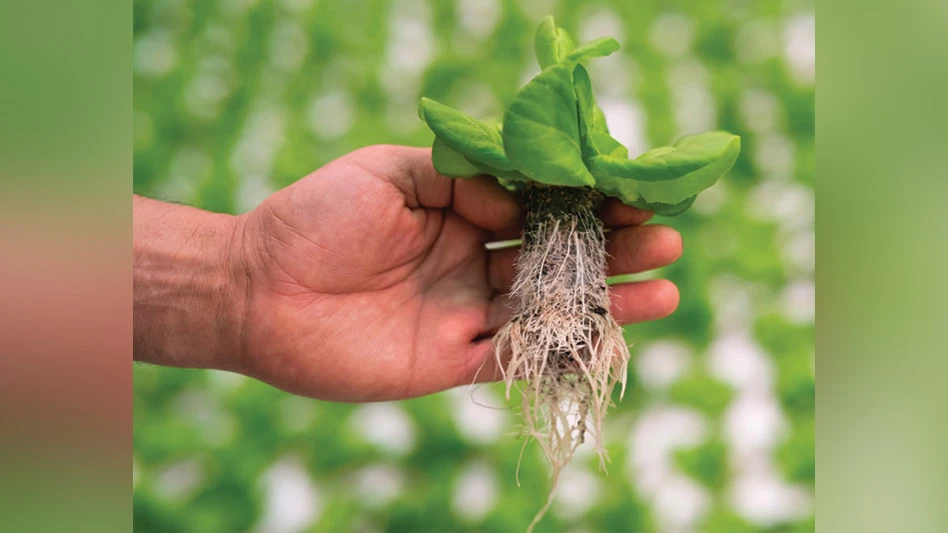
Modern gardening is better than it has ever been thanks to the Jiffy-7 Pellet. The compressed substrate discs have long been stalwarts for growers of all types and sizes, decreasing the effort to grow seeds and plant cuttings in both home gardens and high-tech greenhouses. The technology and innovation behind the pellets are perfect for controlled environment agriculture, too, says Jiffy Global Segment Manager for CEA Kyle Freedman.
“It’s very easy for anyone to use, and I think that’s one of their great benefits. It’s simple for a home gardener who doesn’t know a lot about gardening, but it’s just as simple and effective for a CEA grower who has tons of experience,” he says. “It's really good for any kind of grower or any crop that’s being propagated both by seed or by clonal propagation or cutting. It’s really flexible.”
The versatility and ease stem in part from the Jiffy-7 Pellet design. At its core, the pellet is made by wrapping a small amount of substrate into a polylactic acid (PLA) netting and compressing it up to seven times depending on the type, thus the 7 in “Jiffy-7.” After the pellet is compressed, it is heat treated, making it incredibly lightweight. Rehydration allows the pellets to expand to their regular size in under a minute. Importantly for CEA growers, all Jiffy-7 Pellets are manufactured in facilities that have an ISO 22000 food safety management certification.
“That is not really normal for substrate, but it’s a way for us to ensure that we have the proper protocols in place when we’re producing substrate,” Freedman says. “We minimize handling. So, all our equipment and processing are automated. There are very little human touch points to prevent the introduction of any human pathogens. And the interesting thing about pellets is they’re both compressed and heat treated.”
In addition to being food-safe by default, the construction of the Jiffy-7 Pellets also makes them perfect for hydroponic CEA growers. The pellets work in both NFT and deep-water systems, and because the substrate is enclosed in the PLA netting, there is little risk of substrate entering the hydroponic system and clogging filters.
And while standard Jiffy-7 Pellets will work for most growers, there are also options for the pellet substrate. Where Jiffy once provided just coco or peat, they now offer blends that allow growers to better control how the plug interacts with water.
“We have more and more growers that want a little bit more porosity and aeration, a little bit more flexibility in terms of drying back their plug and then being able to rehydrate and take on water,” Freedman says. “In order to achieve that, we can blend peat and coco as well as even add in wood fiber.”

But customization options don’t end with substrate blending. The substrate can even be tuned to the type of plant a grower is producing. Freedman says he has worked with growers that wanted more or less compression, different sizes and even a different center dimple.
Jiffy also works with automation companies to ensure the plugs are compatible with automation. They have even worked to build specific automation used to rehydrate the pellets “in a matter of 30 seconds,” Freedman says.
But customization of a versatile product is even better when it’s cost effective. Freedman says that the extraordinarily light nature of the Jiffy-7 Pellets makes them very affordable when shipping costs are considered.
“The pellets are a seventh of the actual volume that a grower gets,” he says. “Ultimately, the landed cost of the substrate is the most important. And that’s how you really can compare apples to apples. One plug might be 3 cents. The other might be 5 cents. But if you can have seven times more of the 5-cent plug on a truck, then it’s going to be drastically cheaper.”
Freedman also notes that for growers who want to try the Jiffy-7 Pellet, there is a robust trialing process to make sure it’s the perfect fit. “We consider ourselves a growing solutions company,” he says, noting that when working with a grower, Jiffy will dial in the right customization for the versatile plug. “Often what we start with is one thing, and what we finish with is some variation of that, because a grower has given us feedback, and we can make changes.”

Explore the May/June 2025 Issue
Check out more from this issue and find your next story to read.
Latest from Produce Grower
- OHP expands sales team with new hire and internal promotion
- New internship data empowers horticulture employers
- Resource Innovation Institute and The Ohio State University launch first national CEA training certificate for design and construction professionals
- Farm Bill passes out of House Committee on Agriculture
- Gotham Greens celebrates 15-year anniversary in CEA industry
- [WATCH] Taking root: The green industry’s guide to successful internships
- The Growth Industry podcast Episode 10: State of the Horticulture Industry
- BM2 Automation