Photos courtesy of Jiffy Group
Produce Grower: What are the biggest pain points CEA growers face when it comes to propagation?
Kyle Freedman: While utilizing CEA technology to produce plants has made life easier in some ways, there will always be challenges, such as consistency and ensuring you can produce the ideal plant in a uniform way, every single day. That kind of consistency is difficult, and inputs such as seeds and media make a big impact. Food safety and general reduction of pathogen risk is also critical.
There are different philosophies in CEA propagation and production around microbial life in substrate. For example, media that is pathogen-free and can be validated as such every single time (which are mostly inert or non-organic materials) helps to provide growers with assurance the product is coming in clean.
While all media can ultimately attract microbes (as the plants need them to thrive), ultimately food safety regulations, audits, etc. require strict protocols, and this is one way to fulfill those. On the other hand, using media that has rich microbial diversity can help promote resilience in the event there are pathogens. Both are good options but need to be managed well.
Another challenge is media waste. With food production, the media become unnecessary after certain growth stages and harvest. When we grow food 365 days per year, that is a lot of media we need to dispose of. Even if that media can be composted (which some cannot), it often comes with a management or disposal cost.

PG: How do issues like labor shortages and automation pressure affect the choice of propagation media?
KF: Labor is becoming increasingly expensive, so finding ways to eliminate the repetitive tasks of propagation, such as filling trays, dibbling, seeding, irrigating, transplanting, etc., are all key areas to develop and optimize. When you design a system appropriately, you can eliminate a lot of labor.
But the media also need to be designed for those systems. And we are entering an era where we are improving the engineering of growing media for CEA specifically.
PG: How is Jiffy addressing those CEA-specific growing media needs?
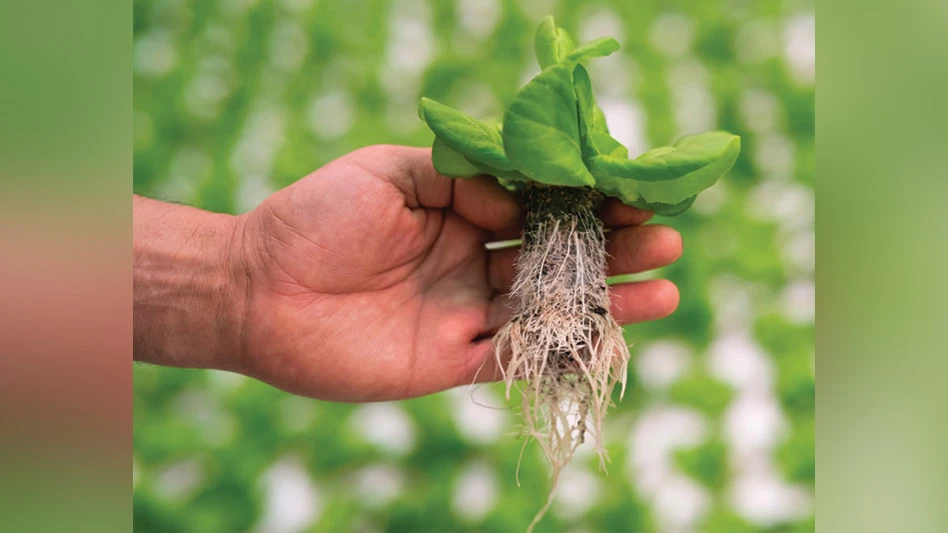
KF: Enter Jiffy Gel! It’s a revolutionary gel-based substrate made up of plant-based materials and water, with no conventional substrate materials, such as peat, coco coir, wood, etc. Jiffy Gel is pathogen-free. The material is completely biodegradable and minimizes the waste post-harvest. It can be made on-site, which can minimize pathogen introduction and reduce the amount of freight necessary to produce the same volume of plants.
For example, one pallet of gel input material can make the equivalent of six truckloads of prefilled plug trays. For growers looking to maximize food safety, sustainability and save costs, that is as close to a silver bullet as I think we can get.

PG: In what ways does this product improve hygiene, consistency and automation-readiness compared to traditional propagation methods?
KF: In addition to using food-safe, dried, processed and clean materials, there is also a heat step that reaches 65 °C or about 150 °F, the point at which you kill plant and human pathogens. In terms of consistency, when filling trays or other propagation cavities, there is nothing more uniform than liquid. Formulations have been designed specifically for automation to ensure the plugs are stabilized through transplanting. In general, once the gel is cured, it is extremely easy to dibble and seed.
PG: For a grower interested in trying Jiffy Gel, what should they expect in terms of ease of use, support and crop compatibility?
KF: It is critical to understand that gel has different properties than conventional substrate, such as peat or coco. Growers must be willing to make some small tweaks to the way they grow and their environmental controls in order to reap the benefits we have outlined. Once those are dialed in, then gel can be easy to manage and used across a multitude of crops. I have not found a crop that did not perform well in gel. After all, being composed of water and nutrients, plants acquire what they need.
Explore the July/August 2025 Issue
Check out more from this issue and find your next story to read.
Latest from Produce Grower
- OHP expands sales team with new hire and internal promotion
- New internship data empowers horticulture employers
- Resource Innovation Institute and The Ohio State University launch first national CEA training certificate for design and construction professionals
- Farm Bill passes out of House Committee on Agriculture
- Gotham Greens celebrates 15-year anniversary in CEA industry
- [WATCH] Taking root: The green industry’s guide to successful internships
- The Growth Industry podcast Episode 10: State of the Horticulture Industry
- BM2 Automation