A quick visit to the produce section of your local supermarket or grocery store reveals that virtually all culinary herbs have already been cut and packaged with a ticking expiration date or are dried. However, you would be hard-pressed to find a grocery store that doesn’t have potted basil, as it is probably the most popular grow-it-yourself herb on the market.
Unfortunately, basil growth is often difficult to control and can often become tall, scraggly or even bent over once it has been in the grocery store a few days.
As it stands today, there are no chemical plant growth regulators (PGRs) labeled for edible culinary herbs. This poses two problems for growers: how to grow aesthetically pleasing potted herbs that are proportional to their containers, and how to ensure the plants fit on shipping racks without causing damage or increasing the cost to ship them. Finding a way to optimize plants for distribution and aesthetics kills two birds with one stone.
We propose the use of ultraviolet (UV) radiation as a potential growth regulator. Previous studies have shown that when UV radiation is removed, plants generally grow taller and become more stretched than plants provided with UV radiation. Many greenhouses use glazing materials that prevent most or all UV radiation. Naturally, we thought it safe to assume that adding UV radiation would inhibit extension growth of basil and possibly increase branching.
Why did we use commercially available LED fixtures that emit UV radiation and not one of the other non-chemical forms of growth regulation? These include mechanical stimulation or restricting irrigation and fertilization.
While these strategies work, they come with their own set of problems. Mechanical stimulation uses physical touch to prevent stem elongation through actions such as attaching a plastic sheet to an irrigation boom and moving it across the crop or blowing compressed air directly onto the crop.
Unfortunately, these methods can create open wounds that may lead to pathogen infection. Plus, does anyone really want another object touching their food? Water and nutrient restriction practices require precise application and timing, which can result in a lot of dead plants if not managed correctly.

UV-A basil study
We chose sweet basil ‘Genovese’ and ‘Nufar’, two of the most commonly grown cultivars. For each cultivar, 100 round 6-inch pots filled with a peat-perlite substrate were evenly dibbled with 15 seeds each.
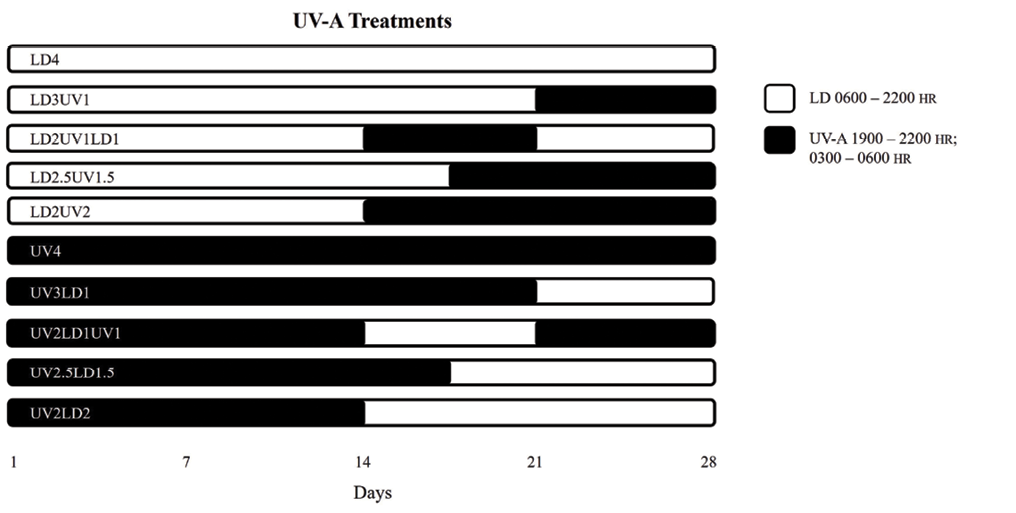
Ten containers of each cultivar were germinated for seven days and randomly assigned to one of 10 treatments receiving various combinations of night interruption UV-A lighting (Figure 1) for 0, 7, 14, 18, 21 or 28 days at the beginning and/or end of growth (Figure 2).
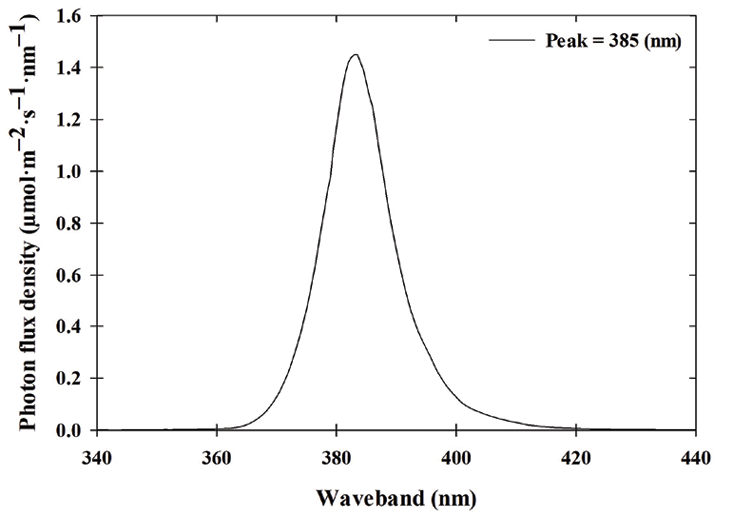
Depending on the assigned treatment, 50 pots of each cultivar were placed on one of two benches: a long-day (LD) bench providing a 16-hour photoperiod consisting of the natural photoperiod plus day-extension lighting, and another bench where a 9-hour photoperiod was created by closing an opaque black cloth over the crop from 5 p.m. to 8 a.m. Additionally, LEDs emitting UV-A radiation with a peak wavelength of 385 nm (Figure 3) and 20 µmol·m–2·s–1 were on from 7 to 10 p.m. and from 3 to 6 a.m.
Thirty-five days after sowing, each container was measured in three dimensions: height (base of pot to tallest point of the plant), width (point of widest dimension) and perpendicular width (turned 90 degrees from first diameter). From these measurements, we calculated the growth index of each plant by averaging the two diameters, adding the height and averaging again. Additionally, we measured the chlorophyll content index (CCI) and the shoot dry mass (SDM) from each container.
Results
For both ‘Genovese’ and ‘Nufar’, plants grown under UV-A radiation for all four weeks lead to the greatest height reduction of 28 and 14%, respectively, compared to plants not exposed to UV-A radiation (Figure 3). ‘Genovese’ and ‘Nufar’ plants exposed to the four-week treatment had growth indices 22 and 9% lower, respectively, than plants not exposed to UV-A radiation. The difference in height and growth index across treatments was much lower for ‘Nufar’ than ‘Genovese’ (Figure 4).
Chlorophyll content
For both cultivars, plants that were exposed to UV-A during the last week before harvest experienced significant declines in chlorophyll content (greenness). This was most prominent for plants under the four-week treatment, where chlorophyll content was half the amount of plants not exposed to UV-A radiation.
This change led to visible differences in color, where plants exposed to UV-A within the week before harvest were a paler shade of green. When given the chance to grow without exposure to UV-A at least during the last week of growth, chlorophyll levels rebounded closer to those seen from plants without any UV-A exposure.
Shoot dry mass
The shoot dry mass of ‘Genovese’ was reduced regardless of UV-A exposure duration or sequence, except for plants that were only exposed to UV-A radiation within the third week of growth (LD2UV1LD1). In contrast, the SDM of ‘Nufar’ was only reduced when plants were exposed to UV-A for at least the first two weeks.

Take-home messages
While both cultivars responded to night interruption UV-A radiation, ‘Genovese’ generally experienced greater reductions in height, growth index, chlorophyll content and shoot dry mass than ‘Nufar’, perhaps because the leaves of ‘Nufar’ are much larger than ‘Genovese’. Because of this, more UV-A may be intercepted by the upper leaves and prevent it from reaching further into the plant canopy. To overcome the weaker response of ‘Nufar’, higher UV-A intensities may be needed.
The reduction in relative chlorophyll content led to paler green leaves. Plant color is one of the many qualities that drive consumer preferences. Often, yellowing or pale green leaves signal that a plant may be of lower quality and could stop a sale. To prevent this, UV-A applications should cease at least one week before the end of production to allow the chlorophyll content and color of basil to recover.
Of all the treatments we tested, the most promising for use on ‘Genovese’ was applying UV-A during the third week of growth (LD2UV1LD1). We chose this treatment because it was effective in reducing the height and GI by 12 and 9%, respectively, without significantly affecting the shoot dry mass. Additionally, this treatment had one of the lowest reductions in relative chlorophyll content at 14%, with minimal impact on leaf color.
While we have shown that NI exposure to UV-A radiation is capable of regulating the growth and size of ‘Genovese’ and to a lesser extent ‘Nufar’, many may wonder how it affects the flavor of the crop. We currently can't answer that question due to restrictions on consuming plants grown within the Michigan State University Research Greenhouses.
But we suspect basil grown under UV-A may have a more intense flavor. The UV-A application may cause the plants to undergo a stress response in which it reallocates energy that would have been used for growth and instead uses it to shore up plant defenses, such as creating more phenolic compounds that give basil its distinct flavor.
Future research is needed to quantify the amount of phenolic compounds within the plant. Furthermore, consumer preference studies are needed to understand if any change in phenolic content can be detected by the human palate.
Latest from Produce Grower
- [WATCH] Advances in growing media for CEA production
- Award winners announced for 2026 PHS Philadelphia Flower Show
- U.S. horticulture operations report $18.3 billion in sales: USDA
- Industry leaders call for action to support economic aid for specialty crops
- Sollum Technologies launches SF-INFINITE, a new LED fixture for commercial greenhouses
- [WATCH] Taking root: The green industry’s guide to successful internships
- ACT announces 2026 event series focused on resilience, energy, efficiency in greenhouse growing
- BioWorks appoints Chris Rose interim general manager