On Tuesday, Thursday and Saturday of each week, you can get the latest industry news right in your inbox with the Produce Grower newsletter, featuring the latest headlines and stories from the magazine. You’ll find everything from exclusive research and industry insights to production tips and breaking news.

Marni Karlin joins CEA Food Safety Coalition as first executive director
The CEA Food Safety Coalition, comprised of leading controlled environment (CEA) leafy greens producers, has announced that Marni Karlin is the organization’s first executive director.
A seasoned public affairs expert with an extensive background in the food and agriculture industry, Karlin will work closely with coalition members, government agencies and industry experts to develop leading food safety standards for the CEA leafy greens industry. In addition to her work on food safety, Karlin’s role will also focus on growing the coalition’s membership, managing day-to-day operations and leading all communications and advocacy work.
>> Read the full story here.

New urban farm opens in Boston’s Hyde Park neighborhood
On Oct. 30, Boston Mayor Martin J. Walsh joined the owners of We Grow Microgreens, elected officials and community members to celebrate Hyde Park’s newest small business, which will bring healthy greens to grocery stores, restaurants and farmers markets across the city. The urban farm was made possible thanks to land made available by Boston’s Department of Neighborhood Development and Community Preservation funds.
“I am proud of the city of Boston’s commitment to the revitalization of this vacant land, creating a new farm and a new gathering space that all of Hyde Park can enjoy,” Walsh said. “I want to thank the owners of We Grow Microgreens for investing in Readville and their community.”
>> Read the full story here.

UF/IFAS launches research to reduce pepper disease
Pamela Roberts, a UF/IFAS plant pathology professor, has been awarded a four-year, $3-million grant from the National Institute of Food and Agriculture, an arm of the USDA, to lead research into ways to reduce bacterial diseases in peppers. Scientists from UF/IFAS, North Carolina State University, the University of Georgia, the Ohio State University, Auburn University and a USDA lab in South Carolina will participate in the pepper disease research.
Plenty of diseases can harm peppers. Most bell peppers are resistant to bacterial spot, but other types of peppers are not, said Roberts, a faculty member at the UF/IFAS Southwest Florida Research and Education Center in Immokalee, Florida.
“Bacterial spot is one of the most damaging and difficult diseases to manage on peppers,” Roberts said. “Yield losses in severely affected crops can reach 100%.”
>> Read the full story here.
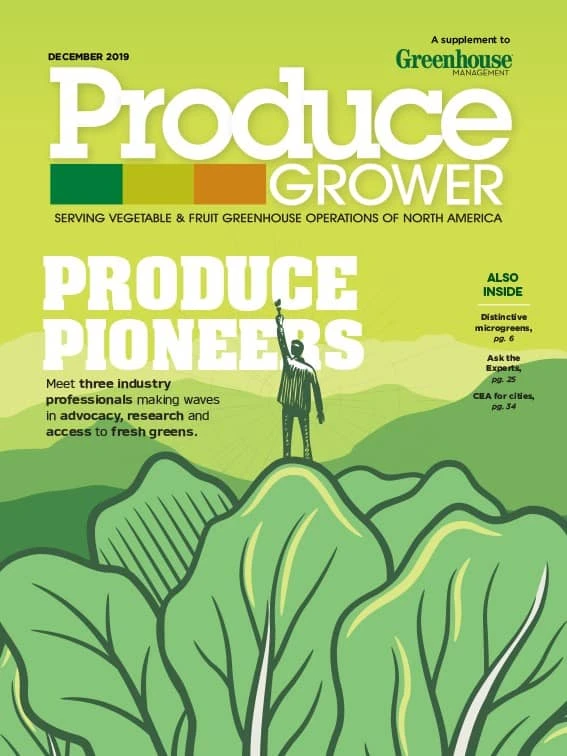
Explore the December 2019 Issue
Check out more from this issue and find your next story to read.
Latest from Produce Grower
- [WATCH] Advances in growing media for CEA production
- Award winners announced for 2026 PHS Philadelphia Flower Show
- U.S. horticulture operations report $18.3 billion in sales: USDA
- Industry leaders call for action to support economic aid for specialty crops
- Sollum Technologies launches SF-INFINITE, a new LED fixture for commercial greenhouses
- [WATCH] Taking root: The green industry’s guide to successful internships
- ACT announces 2026 event series focused on resilience, energy, efficiency in greenhouse growing
- BioWorks appoints Chris Rose interim general manager