Photos courtesy of Signify
Produce Grower: What are some ways greenhouse growers can increase operational efficiency without requiring an expansion or costly upgrades?
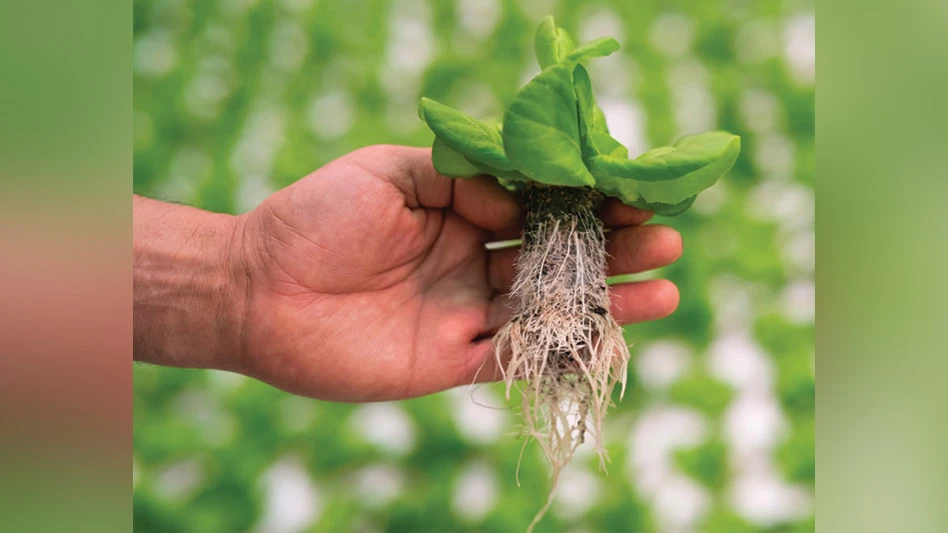
Stefan van de Voort: You don’t need to convert all greenhouses to vertical farms. But there are ways to make better use of existing greenhouses. Many greenhouse growers propagate their plants on a concrete floor or on a table system.
We’ve seen companies building a multilayer propagation facility in one of their greenhouse bays. By making one multilayer, they have more bays available for production, so they save space, and they have more control over their environment. This can result in higher uniformity of plants, shorter propagation cycles and improved plant quality.
There are many setups of vertical farming. You can have it fully automated with robots. But depending on the scale of the company, it can also be a simple climate room with a racking system for propagation, where trays are moved manually.
PG: What are some other benefits of incorporating vertical production in traditional greenhouses?
SV: It is a nice solution for a lot of problems that some greenhouse growers face. In the middle of the summer, it can be challenging to properly propagate tomato young plants because it’s too hot, and they cannot maintain a proper climate inside the greenhouse easily. So, they end up with a lower survival rate and lower-quality plants.
By using some of these indoor farming technologies, they can maintain a stable climate. And they do not need to overseed more plants than they normally do, so they can save money on that. Tomato seeds are very, very expensive. If you can save 5% to 10% on overseeding capacity, that is something that can help them pay back the investment for the vertical farm.
For the financial calculations, we have a lot of tools to help growers in calculating an estimated ROI.

PG: Is this particularly beneficial for young plant production or in more stages of the life cycle?
SV: I’ve been talking about multilayer, but it can also be single layer within a closed environment. But with multilayer, you make better use of space. We have figured out during our trials using vertical systems in the seedling phase can make a highly energetic seedling that gives a good growth start in the greenhouse, and that can give you extra yield without changing the production setup.
PG: What concerns do you hear from growers?
SV: The biggest concern is the initial cost. Yes, the initial investment can sound expensive, but if you calculate the savings on seed costs or extra yield you can get, the payback period can be surprisingly short.
The other question that I get regularly is, “Is this plant going to be shocked going from a nice, cozy, stable indoor environment to a greenhouse, maybe in the middle of summer, with full solar radiation?" We have tested many crops, and we didn’t see any shock. On the contrary, we saw that plants could handle it so well that they performed much better.
Another concern is energy use. Because it’s completely sole source, you need to provide all the light with artificial lighting. But you have to look into how much energy you actually put into one single plant and the extra yield/quality it gives you. Over the total cycle, it can be a big gain.
PG: What are other important considerations?
SV: Dynamic lighting and the way you control your lights through spectral tuning or controlling the intensity through tailored light recipes can be worth more than growers think. They need to be aware of how to use it, and that’s where our 20-plus years of knowledge about plant-light interaction comes in. We have a team of plant specialists who have conducted many research studies to assist our customers, and we also supply the systems to make it all work.
With our GrowWise control system, growers can tweak light recipes to their crops and the growth stage, but they can also save on energy by making use of the smart lighting control based on energy prices and spectrum.

Explore the July/August 2025 Issue
Check out more from this issue and find your next story to read.
Latest from Produce Grower
- OHP expands sales team with new hire and internal promotion
- New internship data empowers horticulture employers
- Resource Innovation Institute and The Ohio State University launch first national CEA training certificate for design and construction professionals
- Farm Bill passes out of House Committee on Agriculture
- Gotham Greens celebrates 15-year anniversary in CEA industry
- [WATCH] Taking root: The green industry’s guide to successful internships
- The Growth Industry podcast Episode 10: State of the Horticulture Industry
- BM2 Automation