John James Staniszewski was in the absolute worst spot imaginable.
Windy City Mushroom's trade show booth at Natural Products Expo West was relegated to the farthest, darkest corner of the Anaheim Convention Center, far from the show’s marquee players. In a Hail Mary pass for the Chicago-based mushroom farm, Windy City Mushroom, and its Fungitarian prepared food line, the company invested its last dollars into convention floor real estate, hoping to land a major client.
What the company possessed, it would turn out, was something attendees wanted and few others at Expo West had.
To truly capture Windy City Mushroom’s remarkable story of persistence, determination and unwavering faith in the medical and culinary power of fungi, we must begin at its roots. Or more accurately, at its mycelial network.
No pain, no gain
Staniszewski had been a gym owner, a dedicated personal trainer and a nutritionist when his life took an unexpected and instant turn. In 2016, the Chicago native suffered a tear in the L4-L5 vertebrae of his lower back, leading to an opiate prescription and a subsequent addiction.
“I’d become a high-functioning drug addict,” he says.
Staniszewski’s recovery journey was difficult. He says Psilocybe cubensis mushrooms helped him find liberation from opioid addiction.
“I just so happened to have some mushrooms in my closet for a year or two and had just never used them (recreationally),” he says. “So, I ate four grams and had my come-to-God moment. I woke up the next day, and I never wanted an opiate again in my life.”
The experience was a profound awakening, and Staniszewski describes this transformative experience as a divine encounter, where a higher power told him: “I’ll save your life if you save the world with mushrooms.”
Soon after, another training injury further reinforced in Staniszewski that the universe was pushing him toward a new career direction. He divested himself from his clients, sold his share of the gym and dedicated himself entirely to mushrooms.
For two-and-a-half years, he lived off his savings, meticulously learning the art of mushroom cultivation through resources on social media and The Shroomery — a popular online community forum with discussions on everything from psychedelic and medicinal uses to culinary gourmet fungi.
Staniszewski began experimenting at home, using shoeboxes to cultivate. He knew he couldn’t solely focus on illegal psychedelics, so he researched other mushroom varieties, quickly discovering the medicinal benefits of lion’s mane for cognitive function, Cordyceps for energy and reishi for sleep.
“From a business perspective, I had to consider what would be most marketable,” Staniszewski says, identifying Cordyceps as his best entrepreneurial option. “If I could create an all-natural substance to boost energy and enhance workouts, I knew I could sell it.”
But growing Cordyceps proved a challenge.


The accidental entrepreneur
“Nobody was really doing it in the United States,” he recalls, describing a small community of enthusiasts on Facebook exchanging tips.
He acquired cultures and began cultivating Cordyceps in small containers. Once he cracked the code, he began producing 15 to 20 pounds a month, a significant amount, given that each tray yielded only about two ounces of the reddish-brown fungi. Staniszewski established a 750-square-foot laboratory and grow room to accommodate his operation.
By 2020, Staniszewski was successfully growing and selling Cordyceps to his fitness contacts and online customers, fetching between $350 and $500 per pound. It was a lucrative venture due to the limited number of growers. Yet, he was drawn back to his divine mission: to “save the world with mushrooms.” Cordyceps, while beneficial, wouldn’t fulfill his vision.
“We need to feed the people,” he concluded, shifting his focus to gourmet mushrooms.
Serendipity intervened in February 2020. An industry article announced a Missouri-based mushroom operation was going out of business and selling all its equipment.
Staniszewski pounced on the opportunity and scheduled delivery for March 10 — the very day the COVID-19 pandemic shut down the world.
Fortunately, a friend with ample land and barns offered storage for his 4,000 square feet of autoclaves, bagging machines and other equipment. Sidelined, he returned to growing Cordyceps.
During this interim, a friend told him about a mushroom operation 10 minutes from his old gym in downtown Chicago. “Inside, there’s three dudes in crazy wetsuits growing mushrooms in a large grow room,” he says.
Windy City Mushroom’s owner, Guy Furman, an experienced aquaponics engineer, had attempted to cultivate shrimp and mussels for Chicago restaurants in the space, a venture that ultimately failed. Leveraging existing restaurant connections, Furman had begun sourcing mushroom blocks and offering them to Chicagoland chefs. Staniszewski got his number.
In Furman, Staniszewski found a kindred spirit who recognized the burgeoning potential and profitability of mushrooms.
“You’ve got a lot of space upstairs,” Staniszewski recalls pitching to Furman. “How about I trade you some time for some space?”
Staniszewski began contributing his expertise, streamlining their mycology processes, perfecting grain spawn production and scaling up cultures. This collaboration swiftly led to the formation of Windy City Cordyceps, their first joint venture, transforming the upstairs of Windy City Mushroom into a large-scale Cordyceps production facility.
For the next eight months, their entrepreneurial synergy was undeniable. But Staniszewski saw the potential to take traditionally expensive mushrooms and produce them at a commodity price point, thereby capturing the entire market.
“We needed to grow them at a scale that made them affordable, because selling them to rich people at farmers markets wasn’t going to expand out the (gourmet mushroom) market,” Staniszewski says.
So, at the start of 2022, they put their remaining financial resources together and rented a sprawling 50,000-square-foot warehouse on Chicago’s South Side, marking the beginning of Windy City Mushroom’s large-scale operation.
Over four intense months, Staniszewski, Furman and six individuals with no prior construction experience built the entire operation from scratch. They incorporated 25 8-foot by 20-foot shipping containers stacked vertically to maximize their grow space.
“People thought we were crazy,” Staniszewski says. “We didn’t have any mushrooms sold yet. I didn’t have any big contracts. We had nothing!”
Fortune, it seemed, was on their side. Just as they prepared to move in, a shiitake farmer offered them a 20-foot autoclave for a mere $3,500 — a piece of equipment that typically costs around $100,000. The autoclave was functional, though it required custom racks and configuration.
They meticulously constructed clean rooms, inoculation stations and incubation rooms, converting the vast warehouse into a highly efficient mushroom farm. Within six months, they were producing hundreds, then thousands, of pounds of mushrooms.

Grind or die
During this rapid expansion, they balanced grow room management, harvesting and deliveries with an aggressive sales strategy.
“We wore every hat together,” he says. “And that’s why I believe it worked: because nobody was above anybody. Everybody did what needed to be done to make it happen.”
Staniszewski dedicated three days a week to knocking on the doors of 15 to 20 downtown Chicago restaurants daily to secure high-end clients already using specialty mushrooms. They built a customer base of around 100 restaurants.
Simultaneously, Staniszewski aimed for grocery store partnerships, though that market wasn’t ready for them yet. This led to the launch of Windy City Mushroom’s first farmers market presence.
They also introduced their initial products: bagged Windy City Cordyceps and Windy City lion’s mane snack chips. The latter, made from thinly shaved and dehydrated lion’s mane, proved to be an unexpected flop.
And they continued to face significant production challenges, including a miscalculation in their initial budget that deprived them of two crucial 25-ton AC units. This forced them to adapt their cultivation methods, developing “summer strains” and “winter strains” to work in harmony with the building’s climate.
As their restaurant deliveries became routine, they began to penetrate smaller co-op grocery stores. Staniszewski relentlessly pursued Pete’s Fresh Market, a local chain known for carrying oyster and occasional lion’s mane varieties.
Recognizing the need to scale for grocery demand, they expanded their grow rooms again, bringing their total to 50 8-foot by 20-foot shipping containers. By 2023, Windy City Mushroom was present in 10 farmers markets and one grocery chain.

Starting a movement
In 2023, “Fungitarian” was adopted. Staniszewski said he and Windy City’s head mycologist and head grower, Matt Lopez, embraced the term to define their unique culinary identity.
“We ate mushrooms every day,” Staniszewski explains. “We needed a label because we weren’t strictly carnivores or vegans, but we ate everything.”
This concept soon evolved into a line of fully cooked oyster mushroom ready-to-eat meals in flavors like barbecue, taco and Asian zing.
To test the market, Staniszewski participated in the Chris Kringle Market, an outdoor holiday market in Ottawa, Illinois. Despite sitting in a hut for three days in near-freezing temperatures, he sold about 100 hot mushroom packs each day. It was a eureka moment.
“That’s what people want,” he says. “They want pre-done, pre-sauced, pre-cooked, easy-to-heat-and-eat meals.”
This revelation spurred him and Furman to fully commit to Fungitarian. They partnered with a co-packer to produce the cubed mushroom meals, allowing Windy City to offer both fresh mushrooms and frozen, ready-to-go options to co-ops and retailers.
With this newfound momentum, they set their sights on major Chicago grocery chains, identifying Fresh Thyme Market as a prime target. Windy City connected with Naturally Chicago, an organization that bridges new brands with grocery stores.
This connection secured official meetings with Fresh Thyme. Staniszewski pitched both their fresh mushrooms and their frozen Fungitarian meals, and Fresh Thyme was sold.
This marked their first major chain deal, placing their products first in seven Fresh Thyme locations, then in all their stores, a significant milestone for Windy City Mushroom.
The big one
In early 2024, despite progress with farmers markets and Fresh Thyme, Windy City Mushroom was producing more product than it could sell.
The company had such a surplus that they began donating to area food banks, Staniszewski says. Yet the financial reality was grim. “We didn’t have any money left. We were about to go under. We couldn’t borrow any more. We were tapped out.”
An opportunity arose to attend the Natural Products Expo West in Anaheim that March — North America’s largest trade show for the natural, organic and healthy products industry and a make-or-break moment for them.
Windy City put the last of its money into Expo West, Staniszewski recalls, and he was determined to land a deal with somebody. “We were going to make this work,” he says.
Located in the absolute worst corner of trade show real estate, Staniszewski and two associates manned a humble display table of five mini Crock-Pots, a basic farmers market banner, a simple tablecloth and fresh mushroom blocks positioned alongside the cooked samples. And then they waited.
“We killed it,” Staniszewski says. “Fungitarian is mushrooms, avocado oil and spices. And the sales rep we brought (to Expo West) knew people from Sprouts (Farmers Market) and Whole Foods and here and there. And once they tried it, they were floored.”
Once tasted, word of mouth took over. Attendees flocked to Windy City Mushroom’s out-of-the-way booth. Their unconventional product was a hit, and the organic buzz echoed that Fungitarian was something special to experience.
Major chains expressed interest, and meetings were lined up, but a significant deal remained elusive.
Just as things looked bleak, a lifeline emerged.
Gourmet mushroom grower Smallhold, a competitor that launched around the same time Windy City Mushroom did in 2020, had declared bankruptcy. In an effort to salvage its Whole Foods relationship, Smallhold needed regional mushroom suppliers to fulfill its commitments, including in the Midwest.
Within two weeks, Windy City Mushroom was shipping to Whole Foods, a $60,000 to $70,000 per month contract.
“That moment saved us,” Staniszewski says. “And it allowed us to continue to grow.”
The partnership opened doors to other major retailers, like the Meijer supercenter chain. Today, Windy City’s mushrooms are sold in more than 350 U.S. grocery stores.
From that pivotal moment, Windy City Mushroom continued expanding. Additionally, they are securing funding to complete the remaining grow rooms. Once finished, Windy City Mushroom will have 75 vertically stacked 8-foot by 20-foot shipping containers, projected to yield 35,000 pounds of oyster and lion’s mane mushrooms per month at full capacity.
Estimates from Staniszewski’s research have the gourmet and medicinal mushroom market as a $14 billion industry.
The global movement
Staniszewski left Windy City in August 2024 to develop a new supplement line produced by a separate company, where he serves as president and CEO. His supplement venture is not part of Windy City.
Staniszewski estimates nearly 400 new mushroom-based products have flooded the supplement market. He believes many of them are substandard, with poor absorption rates rendering them nearly ineffective.
Staniszewski and his team developed USA-grown organic mushroom products, including liposomal tinctures and gummies. Through a unique extraction process, Staniszewski says they achieve a greater absorption rate compared to conventional products.
“My whole mission right now is to get 10 million Fungitarians by 2027 through my products, through education, endorsements and through community (namely the movement’s website, fungitarian.life) by giving people real products made in the USA from mushroom farmers,” he says. “We’ve got a nutritional problem in this country. We’re trying to help people see we’re investing our time into something that will yield a significant return, not just in dollars, but in the health of those consuming our food.”
Editor's note: This article was updated Aug. 12 to clarify information previously published about Staniszewski's current involvement with Windy City Mushroom. He started working for the company in 2022, not 2021, as previously reported, and left in August 2024. At the market, they sold 100 packs per day, not 1,000. We regret the errors.
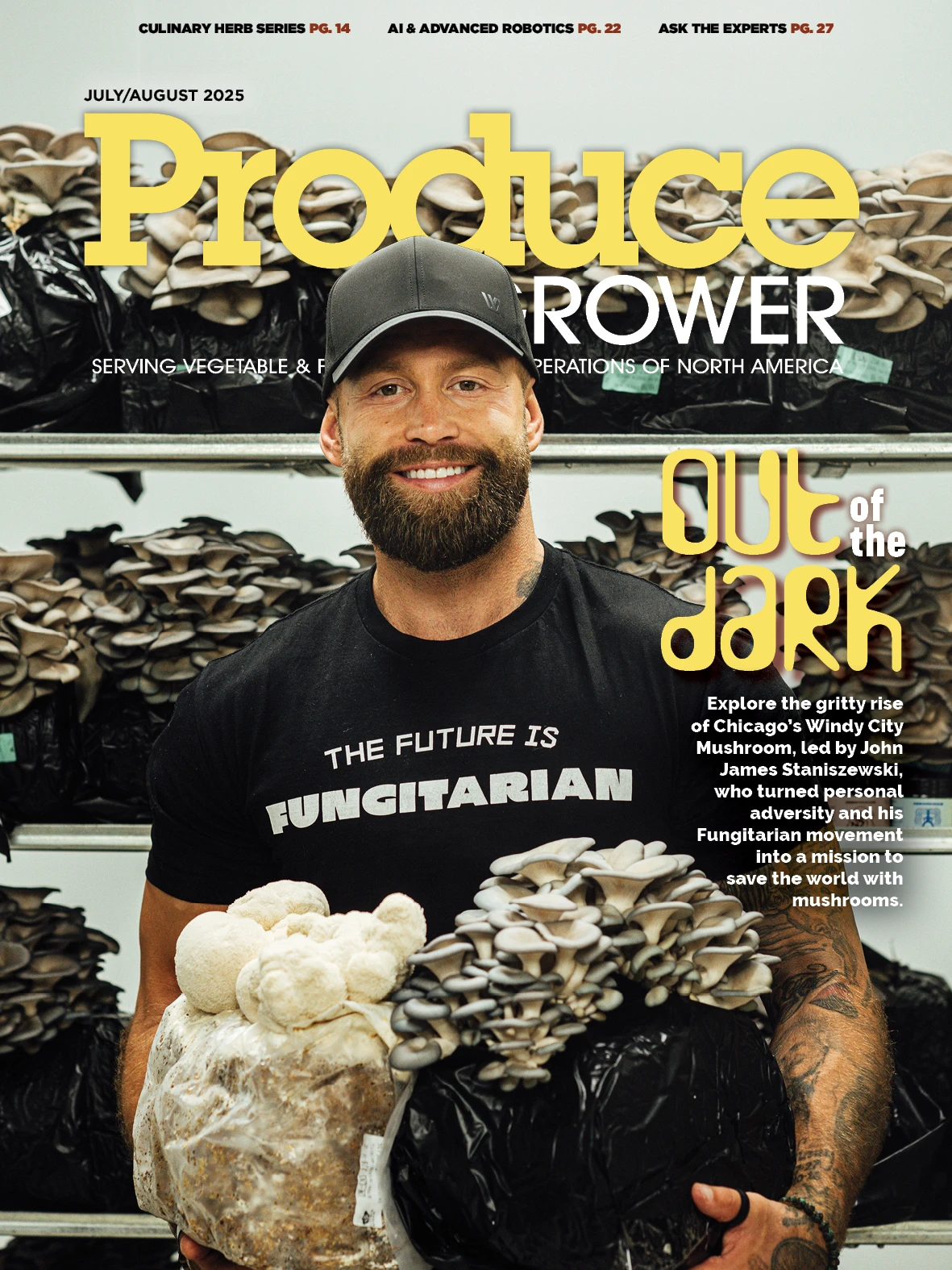
Explore the July/August 2025 Issue
Check out more from this issue and find your next story to read.
Latest from Produce Grower
- OHP expands sales team with new hire and internal promotion
- New internship data empowers horticulture employers
- Resource Innovation Institute and The Ohio State University launch first national CEA training certificate for design and construction professionals
- Farm Bill passes out of House Committee on Agriculture
- Gotham Greens celebrates 15-year anniversary in CEA industry
- [WATCH] Taking root: The green industry’s guide to successful internships
- The Growth Industry podcast Episode 10: State of the Horticulture Industry
- BM2 Automation