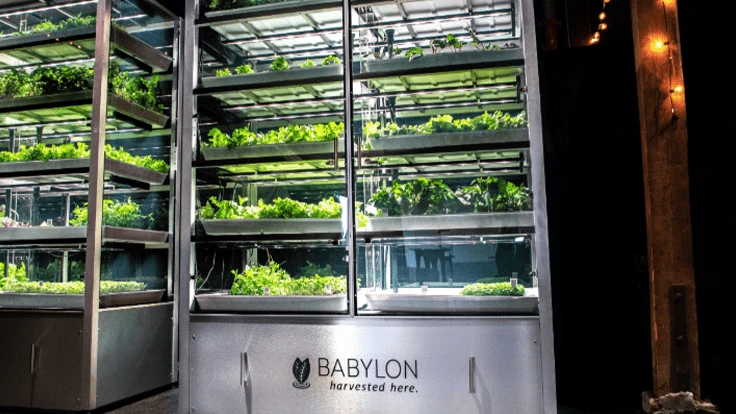
Photo courtesy of Babylon Micro-Farms' Facebook page
Modular micro-farming is a subset within this niche, using small, automated modular food-growing equipment, often contained within a few square feet. Modular farms are easier to use and possibly more scalable, since they can fit into almost any home or apartment.
One example of this modular approach is Babylon Micro-Farms, a startup based in my hometown of Charlottesville, Virginia. The company sells 32” x 66” x 96” tall machines that use controlled environment hydroponics to grow leafy greens, herbs and edible flowers. The farms don’t have soil, sunlight or standard seeds. Instead, Babylon places seed pods onto its trays. Depending on the seed variety (Babylon has 227 of them), the machines use remotely-managed equipment to cast the appropriate water and light. This causes produce to generate significantly more per-acre yield than standard farms. Babylon’s 15sqft micro-farms are capable of producing as much produce as 2000 sqft of outdoor farmland.
This piece was written by Forbes contributor Scott Beyer
Latest from Produce Grower
- Fresh Express releases four new Chopped Salad Kits
- Orbia Netafim releases AI-powered Dosing 5G product range for precision fertigation
- Village Fresh Greenhouse Grown appoints Helen Aquino vice president of innovation
- Resource Innovation Institute and North Dakota State University explore co-location of data center and greenhouses
- When CapEx kills the farm
- Rethinking competition
- The National Association of State Departments of Agriculture sets 2026 federal policy focus
- 3 takeaways from Indoor Ag-Con’s ‘The State of CEA Finance’ keynote panel