.jpg)
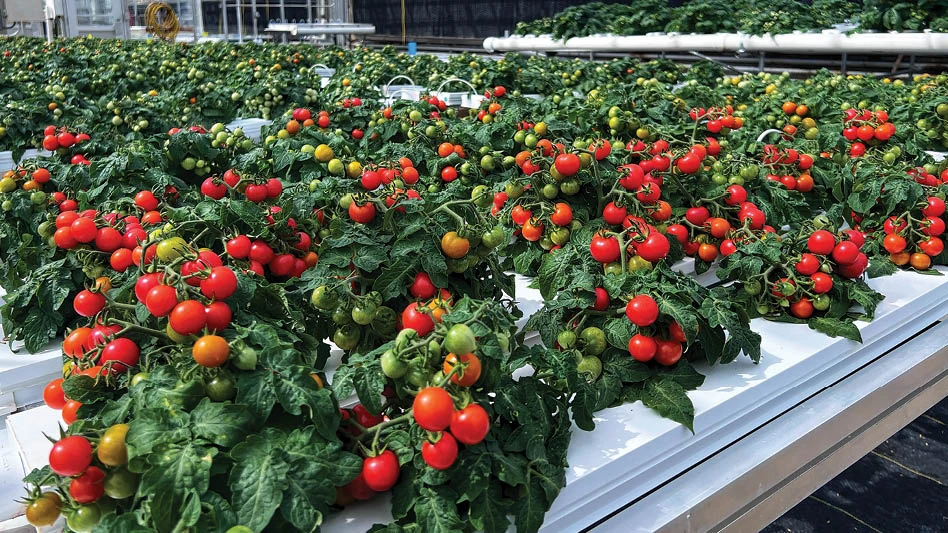
Photo: An employee picks tomatoes at Backyard Farms in Madison. The company's 23-acre greenhouse was completed last year and the first harvest was in January 2007. Currently there are about 340,000 tomato plants in the greenhouse, which employs 115 people. Courtesy of Bangor Daily News.
Backyard Farms, which grows 27 million pounds of tomatoes a year in its greenhouses in Madison, last week began to rip up its entire crop of half a milion tomato plants in an effort to eradicate an infestation of white flies.
The decision to replant its entire crop means the firm’s tomatoes, marketed as Backyard Beauties at supermarkets such as Hannaford and Shaw’s, will be unavailable until late October, according to Michael Aalto, a spokesman for Backyard Farms.
The company employs 200 people, and will not lay off any workers as a result of the decision to rip up the plants and clean out the greenhouses, Aalto said.
Aalto would not reveal how much the decision will cost the company, or whether the company had insurance to cover the destruction of its crop. But there’s no doubt such a business decision will affect the company’s bottom line, according to John Mahon, a professor of business at the University of Maine.
“No manager on Earth wants to turn the switch off,” Mahon said. “No one makes that decision lightly.”
The long-term consequences, however, shouldn’t be too harmful for the company, Mahon said. While most consumer products companies would tremble at the idea of taking their products off the market for three months for fear of competitors stealing their market share — think Coca-Cola versus Pepsi — Backyard Farms is somewhat immune to that scenario, Mahon said.
“People are going to switch in the interim, but the thing that helps [Backyard Farms] in this case is that when you come to December and January,” it’ll be the only source for Maine-grown tomatoes, Mahon said.
The timing of the crisis minimizes its potential damage for Backyard Farms. The company’s tomatoes are most in demand during wintertime, when local farm and home-grown tomatoes are unavailable. During the summer, however, Backyard Farms competes with those other options.
“They’re pulling tomatoes out of the supply right when the local stuff comes in, so it’s really good for local growers,” said Eric Sideman, organic crop specialist at the Maine Organic Farmers and Gardeners Association. “They don’t lose as much money because their tomatoes aren’t as much in demand and it’s better for the consumer because they have so many choices. They don’t have to buy Mexican hothouse tomatoes; they can buy local tomatoes this time of year.”
However, Aalto said the company did not delay its decision to rip up the crop until summer arrived. It was just a convenient coincidence.
“The fly issue had been taking place for a relatively short amount of time leading up to the cleanout,” Aalto said. “The timing where we made a decision to do a cleanout happened to coincide with the summer time frame.”
Latest from Produce Grower
- Fresh Express releases four new Chopped Salad Kits
- Orbia Netafim releases AI-powered Dosing 5G product range for precision fertigation
- Village Fresh Greenhouse Grown appoints Helen Aquino vice president of innovation
- Resource Innovation Institute and North Dakota State University explore co-location of data center and greenhouses
- When CapEx kills the farm
- Rethinking competition
- The National Association of State Departments of Agriculture sets 2026 federal policy focus
- 3 takeaways from Indoor Ag-Con’s ‘The State of CEA Finance’ keynote panel