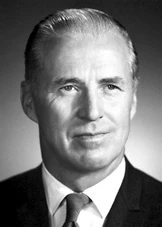
Norman Borlaug was born a simple Iowan farm boy on March 25, 1914. He grew up around wheat and spent his childhood working a 106-acre farm. His early days were simple and bore the strong mark of Americana. But what he did with his life, and with wheat, was far from simple..jpg)
It was spectacular.
Borlaug is now known as one of the greatest Americans to have walked the Earth. He was the recipient of the Nobel Peace Prize, the Congressional Gold Medal, the Presidential Medal of Freedom, and the Padma Vibhusan (India's second highest civilian honor). His legacy is adorned with phrases like "The man who saved a billion lives."
While working in Mexico in the 1940s and 50s, Borlaug developed high-yield, disease resistance wheat varieties and a double-season production system. According to the USDA, Borlaug's discoveries increased Mexican wheat production by six times its previous average and made Mexico a wheat exporter. His discovery decreased food shortages throughout Central and South America.
Following his success in Mexico, Borlaug took his "miracle" dwarf wheat to Southern Asia and the Middle East, specifically India and Pakistan. In the early 1960s, India and Pakistan were teetering on the brink of war and millions of people were set to become victims of starvation. Borlaug's team spent years dodging conflict and finding a solution to the two nation's dearth of available food.
Between 1965 and 1970 wheat production in South Asia nearly doubled. Borlaug's work became the flag bearer for the "Green Revolution." He is now credited with saving an untold number of lives.
Borlaug received the Nobel Peace Prize in 1970 as commendation for his work.
Borlaug was honored last week on his birthday, which also happened to be National Agriculture Day, with a statue in his likeness at the National Statutory Hall in Washingont, D.C.
Agriculture Secretary Tom Vilsack released a statement on Borlaug's statue, saying "Dr. Borlaug's legacy influences our work at USDA to equip the next generation of researchers and agricultural leaders with the sophisticated tools they'll need to address the challenges of a changing climate and a growing global population."
Sources and for more information: the USDA website, the Dallas Observer article on Borlaug, and Borlaug's Nobel Prize page.
Photo: Courtesy of nobelprize.org.
Latest from Produce Grower
- The Growth Industry Episode 10: State of the Horticulture Industry
- Bimi Baby Broccoli partners with Cal-Organic Farms
- Millennium Pacific Greenhouses launches California Grown Cucumber Program
- Scientists develop vitamin A-enriched tomato to fight global deficiency
- UTIA and UT Knoxville research teams will develop automated compost monitoring system
- [WATCH] Advances in growing media for CEA production
- [WATCH] Taking root: The green industry’s guide to successful internships
- Award winners announced for 2026 PHS Philadelphia Flower Show