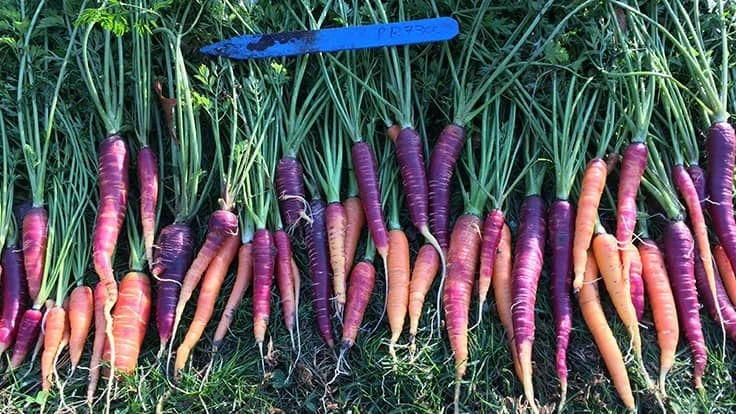
Photo courtesy of Purdue University
The fungus
Alternaria dauci is one of the most damaging pathogens in carrots, killing
leaves above the ground and sometimes rotting the vegetables growing in the
soil. Pesticides can be used to control the fungi, but they’re not widely
available in developing countries and can’t be used in organic systems.
Purdue
University scientists have another solution. Rather than spray above ground,
they’ve found that cultivating microbes under the ground can help keep carrots
safe from Alternaria dauci.
The presence of some types of endophytes, bacteria that live symbiotically within a plant’s roots, can decrease the chances of carrots being damaged by Alternaria dauci. Lori Hoagland, an associate professor in horticulture and landscape architecture, and Sahar Abdelrazek, a former graduate student, wanted to know whether soil health and carrot genetics could affect the presence and number of endophyte communities that can suppress this pathogen in carrots.
“There has been
a lot of research on how microbiomes affect human health and the more widely
planted commodity crops, but this is one of the first studies to look at an important
root vegetable crop like carrots,” said Hoagland, whose findings were published
in the journal PLOS ONE. “We found that breeding and soil health can play
significant roles in the number of endophytes present and their ability to
protect carrots from this devastating disease.”
In field and
greenhouse trials comparing soils and carrot genotypes, Hoagland and Abdelrazek
found that crop management practices were connected with the health of soils
and the number and diversity of endophytes that protected carrots from fungal
disease.
The organic system had 16 percent more total soil organic matter and 43 percent more microbial biomass. Carrots grown in the organic system also had 50 percent more bacterial endophytes than those grown in the conventional system. Moreover, the organic carrots contained eight types of beneficial bacteria that could suppress the pathogen compared to only one in the conventional carrots.
In the field trial, there was no difference in carrot root yield, but pathogen pressure can vary dramatically given environmental conditions, making it difficult to quantify disease suppression in the field. However, given the results of this trial, the scientists suspect that the carrots grown in the organic system would be better able to resist disease if environmental conditions were suitable for the disease to develop.
Results of these experiments also demonstrated that carrot genotype can play a role in supporting endophytes that can suppress this disease. In field trials, two of the nine experimental carrot genotypes had 34 percent and 93 percent lower disease severity in the organic system versus the conventional. Results of the greenhouse trials confirmed that differences in the ability of different carrot genotypes to resist the disease were related to their ability to host the beneficial endophytes.
“This demonstrates the potential effects of genotype, or variety, on a plant’s ability to harness the benefits of organic, healthy soils,” Hoagland said.
The research is part of the Carrot Improvement for Organic Agriculture (CIOA) program, a long-term breeding project aimed at addressing the needs of organic carrot farmers. Funded by the U.S. Department of Agriculture’s National Institute of Food and Agriculture, it brings together scientists from Purdue, the USDA’s Agriculture Research Service, the University of Wisconsin, the Organic Seed Alliance, the University of California Riverside, Washington State University and University of California Extension.
Hoagland said better understanding of the microbiomes of the soil — and the ways in which breeders and growers can affect them — can lead to invaluable methods of reducing disease, fighting weeds and addressing other needs of specialty crop growers.
“We’re still in the early stages of this work, but we see this as a tool that breeders can use when developing new carrot varieties,” Hoagland said. “Growers, too, may one day be able to impact the number and types of beneficial microbes to protect their plants. If growers focus on the health of their soils, they can see some benefits now.”
Latest from Produce Grower
- The Growth Industry Episode 10: State of the Horticulture Industry
- Bimi Baby Broccoli partners with Cal-Organic Farms
- Millennium Pacific Greenhouses launches California Grown Cucumber Program
- Scientists develop vitamin A-enriched tomato to fight global deficiency
- UTIA and UT Knoxville research teams will develop automated compost monitoring system
- [WATCH] Advances in growing media for CEA production
- [WATCH] Taking root: The green industry’s guide to successful internships
- Award winners announced for 2026 PHS Philadelphia Flower Show