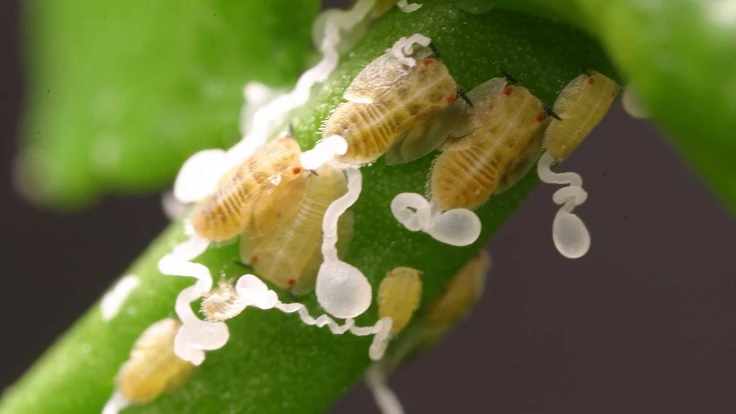
LAKE ALFRED, Fla. --- The disease that threatens to destroy Florida’s $10.7 billion citrus industry appears to have its own mechanism to promote its spread, making it harder to control. A recent study by five University of Florida researchers shows Asian citrus psyllids fly earlier in their life cycles, more frequently and farther when they are infected with the citrus greening bacterium.
Kirsten Pelz-Stelinski and the team of researchers at UF’s Institute of Food and Agricultural Sciences’ Citrus Research and Education Center in Lake Alfred say these conclusions have global implications for how the disease spreads and strategies to control it.
“To our knowledge, this is the first description of direct changes to insect behavior caused by a bacterial pathogen in an insect-plant-pathogen system,” said Pelz-Stelinski, whose work in the entomology and nematology department focuses on insect carriers of plant diseases. “These newly discovered behavior changes seem to increase dispersal of the insect – and thus the disease.”
Citrus greening bacterium first enters the tree via the psyllid, which sucks on leaf sap and leaves behind greening bacteria. The bacteria then move through the tree via the phloem – the veins of the tree. The disease starves the tree of nutrients, damages its roots and the tree produces fruits that are green and misshapen, unsuitable for sale as fresh fruit or, for the most part, juice.
Most infected trees eventually die and the disease has already affected millions of citrus trees in North America. It has recently been found twice in California.
Click here to read more.
Latest from Produce Grower
- The Growth Industry Episode 10: State of the Horticulture Industry
- Bimi Baby Broccoli partners with Cal-Organic Farms
- Millennium Pacific Greenhouses launches California Grown Cucumber Program
- Scientists develop vitamin A-enriched tomato to fight global deficiency
- UTIA and UT Knoxville research teams will develop automated compost monitoring system
- [WATCH] Advances in growing media for CEA production
- [WATCH] Taking root: The green industry’s guide to successful internships
- Award winners announced for 2026 PHS Philadelphia Flower Show