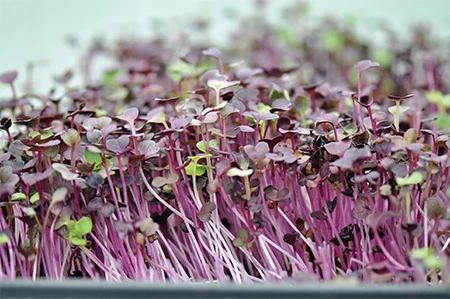
Growers interested in diversifying their current product offering would be wise to consider microgreens. The tiny crops are increasing in popularity with restaurants and other high-end food preparation facilities, particularly for their use as garnish with salads, fish and meats.
While there are some companies that have made their primary crop microgreens, the majority of producers will have a primary crop (tomatoes, lettuce, peppers) and use production of microgreens as a supplement to their standard production.
CropKing horticulturist Maxwell Salinger works with a host of operations that are either growing microgreens as a primary crop or as a supplementary crop.
“Basically, growers are taking different brassicas or arugula or spicy-type greens, germinating them, and then letting them grow out for a week or two weeks. Then, instead of letting them completely grow out, they harvest when they have their first true leaves,” he says. “That gives them a very, very small plant but one that is very spicy or has a lot of taste.”
Salinger says that most microgreen production is done in large, 10 by 20 trays, or on a seedling mat. Each tray will receive a couple of ounces of seed. Contrary to other hydroponically grown produce, however, when growing microgreens there should not be constant irrigation. Instead, growers should employ a media that holds water well and irrigate on a cycle. Salinger says, for instance, use a water pump that will turn on for 30-seconds or a minute each hour.
“If you have an Nutrient Film Technique (NFT) system, or a standard growing system, you might have to make some modification to it,” Salinger says. “One of the more common medias we see with our growers is burlap. We use a food-grade, food-safe burlap that you seed on top of. Then you have to be very careful with your watering schedule.”
The short growing cycle also means that growers don’t have to worry as much about deficiencies and infections brought on by pests. That said, microgreens are susceptible to fungal problems and molds and require growers to stay on top of proper channel sanitation.
And because of the quick turnaround time for harvest, growers need to be cognizant of microgreen’s short shelf-life, which makes them attractive to restaurants, direct-to-consumer sales, food preparation facilities and unappealing to most grocery stores.
“Growers are doing a lot of mixes, working with different cresses and spicy greens. People will also do cornflower sprouts and sunflower sprouts and you can do a lot of customization and customer-specific catering,” he says. “You can tell a restaurant customer that you make this mix specifically for them.”
Latest from Produce Grower
- The Growth Industry Episode 10: State of the Horticulture Industry
- Bimi Baby Broccoli partners with Cal-Organic Farms
- Millennium Pacific Greenhouses launches California Grown Cucumber Program
- Scientists develop vitamin A-enriched tomato to fight global deficiency
- UTIA and UT Knoxville research teams will develop automated compost monitoring system
- [WATCH] Advances in growing media for CEA production
- [WATCH] Taking root: The green industry’s guide to successful internships
- Award winners announced for 2026 PHS Philadelphia Flower Show