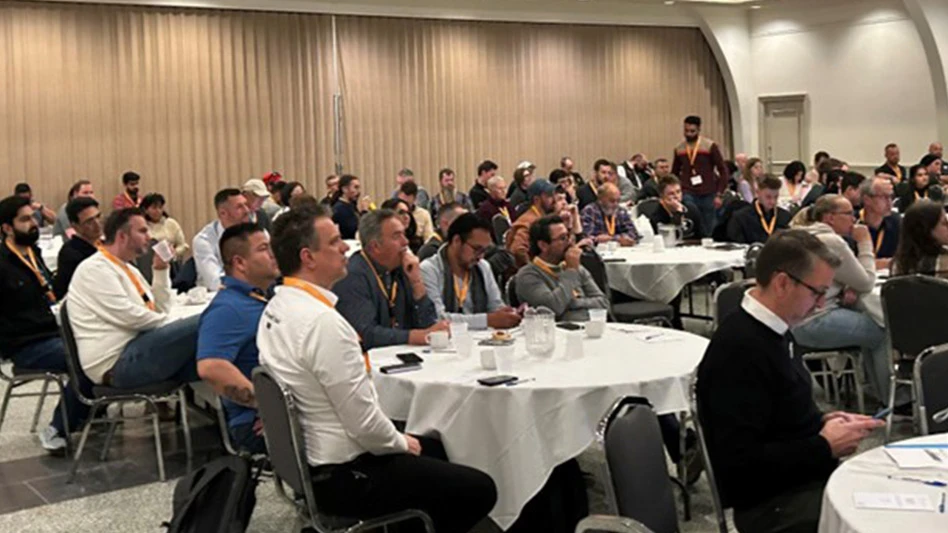
At Indoor AgCon Las Vegas on April 6, 2016, CropKing’s Steve Froelich presented a bright green slide with the phrase, “Think like a plant,” written boldly with exclamation points, followed by, “Know and understand the jobs of the plant.”
As a greenhouse grower, that may seem like an obvious mantra to follow, but Froelich says growers can often get away from what plants really need to grow their best based on our own human assumptions.
“The older I get, I’ve really come around to this belief that lots of growers and engineers sometimes lose sight of what is important for the plant, and we start designing systems and treating systems and running systems like what we as a person would feel comfortable with,” Froelich later said in an interview with Produce Grower. Sometimes we have to go back to the basic plant processes, like photosynthesis, respiration and transpiration.
To better understand plants’ needs, Froelich offers some tips — like investing in a good light meter to get a better understanding of the amount of light that is at the leaf level, which will lead to better photosynthesis.
“You go into that greenhouse every single day. It’s light in there. The plant is obviously growing. But is it at its peak efficiency? I’m sure if we were to measure the light levels at a particular leaf in that plant, and then go outside and measure those light levels, there would be a huge difference between those two numbers.”
Froelich provides another example. “[When] dealing with humidity, sometimes we go in the greenhouse and our body senses, ‘Oh, it’s way too humid in here, so we need to pull moisture out.’ And the reality of the fact is, yes, it may be uncomfortable for us, but it might have been in the comfort zone for that particular plant that you were growing,” he says.
Figure 1.

Source: Steve Froelich, engineer and technical consultant for CropKing, Inc.
Instead of adjusting the temperature based on our own senses, Froelich says that a controller, or even electronic handheld units, have the ability to determine relative humidity — which is the amount of moisture in the air relative to the area’s current temperature.
“If you decrease temperature, and don’t do anything with relative humidity, or the amount of water in the air, as you actually decrease them temperature, the humidity will increase. Hence if you go the other way, keep the amount of water in the air constant, and you raise the temperature, relative humidity in the air is going to decrease,” Froelich says. “In other words, as you start putting more and more water in that air, there’s less and less room for that plant to push water from its leaves into the air.”
For the plant, Froelich says, the comfort range in regard to relative humidity will be in the green zone in Figure 1.
He says variables like these are why it’s so important to understand the basics of how a plant works. “I think we as humans think that we know more than the plant. The reality is Mother Nature figured this out long before we were here,” Froelich says. “And this is why we grow in a greenhouse, so that it gives us control to really be able to dial this in — to hopefully find that happy point to really maximize growth, and maximizing growth is going to give us more product.”
Latest from Produce Grower
- The Growth Industry Episode 10: State of the Horticulture Industry
- Bimi Baby Broccoli partners with Cal-Organic Farms
- Millennium Pacific Greenhouses launches California Grown Cucumber Program
- Scientists develop vitamin A-enriched tomato to fight global deficiency
- UTIA and UT Knoxville research teams will develop automated compost monitoring system
- [WATCH] Advances in growing media for CEA production
- [WATCH] Taking root: The green industry’s guide to successful internships
- Award winners announced for 2026 PHS Philadelphia Flower Show