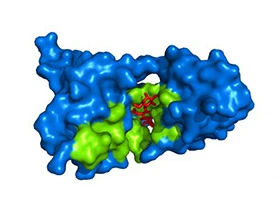

Photo: Fungi can make themselves invisible to the defence system of plants by producing a protein (blue & green) that encloses chunks of chitin, originating from the fungus cell wall (red). Courtesy of phys.org.
Many fungi can make themselves invisible to the immune system of plants. Scientists from Wageningen University have discovered that the tomato fungus Cladosporium manages this by enclosing chunks of chitin originating from its own cell wall in a protein it specifically produces for this purpose. This prevents the tomato plant from sensing that it is being attacked by the fungus, which has free rein to infect the plant.
Back in 2010, scientists at Wageningen University, part of Wageningen UR, learned that the fungus Cladosporium produces a compound– the so-called Ecp6 protein – which makes it invisible to the immune system of plants. The immune systems of plants and animals use special compounds to destroy invading micro-organisms such as fungi. For instance, the immune system uses chitinases, enzymes that can dissolve the cell walls of fungi, to combat fungal infections. This process releases pieces of chitin, that allow plants to sense the presence of an intruder, and to reinforce the immune response. The fungal Ecp6 protein binds to these chitin pieces. "The protein from the fungus seeks out these pieces of chitin and adheres to them," Professor Bart Thomma explains. "This hides the chitin particles from the tomato plant the same way that a stealth aircraft is invisible to radar. The immune system of the tomato plant therefore no longer receives the signal to ramp up its activity, allowing the fungus to infect the plant without being noticed."
Andrea Sánchez-Vallet, a scientist in Bart Thomma's team, worked together with crystallographers at the University of Lübeck, Germany, to find out how exactly this process works. They already knew that plants can detect pathogens through immune receptors. Certain domains within these receptors, the so-called LysM domains, are able to bind to chunks of chitin from fungi, generating the signal that an intruder came in.
Read the rest of the story here.
Latest from Produce Grower
- The Growth Industry Episode 10: State of the Horticulture Industry
- Bimi Baby Broccoli partners with Cal-Organic Farms
- Millennium Pacific Greenhouses launches California Grown Cucumber Program
- Scientists develop vitamin A-enriched tomato to fight global deficiency
- UTIA and UT Knoxville research teams will develop automated compost monitoring system
- [WATCH] Advances in growing media for CEA production
- [WATCH] Taking root: The green industry’s guide to successful internships
- Award winners announced for 2026 PHS Philadelphia Flower Show