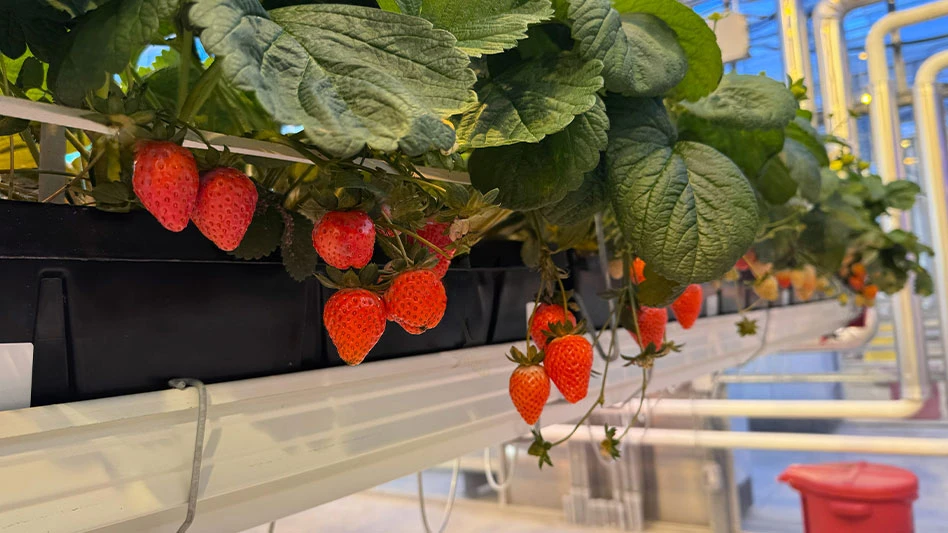
A team of University of Arizona researchers is looking at ways to grow strawberries hydroponically in a greenhouse. The effort is being led by Chieri Kubotoa, a widely published professor in the UA of School of Plant Sciences and the Department of Agricultural and Biosystems Engineering, and a member of the UA's BIO5 Institute.
Growing up in Tokyo, Kubota savored fresh strawberries in the winter. It wasn’t until she studied agriculture in college that she learned that fresh strawberries in winter are, as she puts it, "an unusual cycle against nature."
Today Kubota is trying to perfect that off-season cycle and grow strawberries hydroponically in a greenhouse in the UA Controlled Environment Agriculture Center, which is part of the College of Agriculture and Life Sciences. Her goal is to introduce sustainable strawberry cultivation to local greenhouse growers and provide sweet luscious berries for restaurants, high-end grocers and farmers markets.
She knows it can be done. "I'm from Japan. We grow strawberries in greenhouses in winter." And some of those strawbewrries are grown hydroponically.
In the United States the majority of strawberries are grown in California. The plant varieties – or cultivars – are bred for that climate. In the desert, even in a greenhouse, it's a challenge to approximate that mild misty coastal climate.
Kubota's co-principal investigator on the project is research specialist Mark Krogge, who designed an under-the-bench fog system that releases humidity at night so the strawberries are dewy moist by dawn. It's turned on for five minutes at time, three times an hour, for three hours.
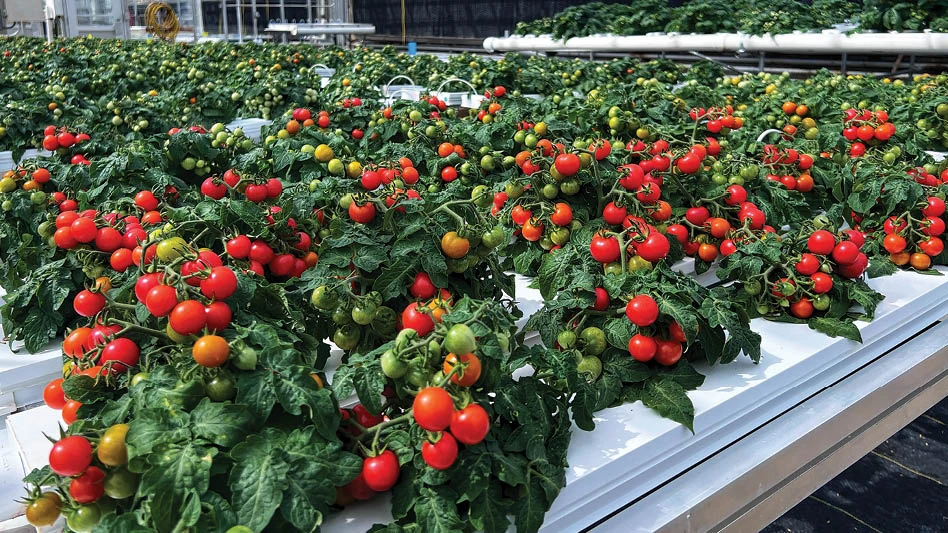
They experiment to identify optimal growing conditions for sustainable off-season hydroponic strawberries. Strawberries are harder to grow hydroponically than tomatoes or lettuce. The humid strawberry greenhouse is bathed in bright diffused light. Plants are growing in special styrofoam troughs from Japan that maintain a healthy temperature. The troughs are suspended by chains in long rows at waist height. Bright red berries peek out from lush green leaves.
In Japan, which produces some 259 million pounds of strawberries annually, new flavorful varieties are patented like drugs.
"We recently got some off-patent plants from Japan, but their condition was not so good," Kubota said. "Now we're in the tissue-culture stage to get better plants, healthier plants. Next year we hope to plant them in the greenhouse. This is not a high-yield variety – but it is really flavorful," she said. "These are relatively old varieties that we hope we can propagate and share with growers."
here is a lack of information available about growing greenhouse strawberries, which is one reason this UA research is so valuable. The project was one of 18 in the nation selected for funding by the Walmart Foundation in 2013. The grants are administered by the University of Arkansas.
Source: University of Arizona College of Agriculture and Life Sciences
Photo: Chieri Kubotoa
Latest from Produce Grower
- Fresh Express releases four new Chopped Salad Kits
- Orbia Netafim releases AI-powered Dosing 5G product range for precision fertigation
- Village Fresh Greenhouse Grown appoints Helen Aquino vice president of innovation
- Resource Innovation Institute and North Dakota State University explore co-location of data center and greenhouses
- When CapEx kills the farm
- Rethinking competition
- The National Association of State Departments of Agriculture sets 2026 federal policy focus
- 3 takeaways from Indoor Ag-Con’s ‘The State of CEA Finance’ keynote panel