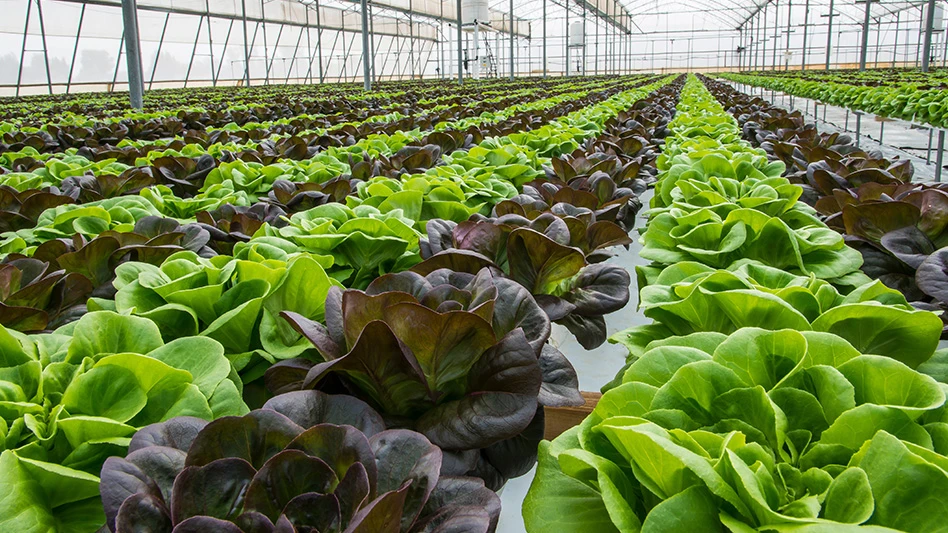
The world of leafy greens is expansive and potentially profitable for produce growers as a growing number of consumers clamor for fresh and nutritious produce. Here are five leafy greens from the The Complete Leafy Greens Cookbook by Susan Sampson, ©2013 Robert Rose Inc., www.robertrose.ca that you may not have ever eaten, but perhaps should. Furthermore, you may want to add them to your production plans for 2014.
Carrot Tops. Carrot greens are bitter, herbaceous and astringent, with a hint of sweetness in the finish. They are coarse and grainy when raw. The stems taste like celery but are too stringy to use. Although no official government analysis is available, carrot tops probably have a nutritional profile similar to their roots. This would suggest that carrot tops provide vitamins A, B6, C, and K, folate, manganese, niacin, potassium and thiamin.
Chickweed. The raw leaves are soft and delicate. They taste herbaceous, slightly spinachy, and astringent. The flowers and stems are nutty, with a slightly bitter finish. When cooked, chickweed leaves are milder and taste faintly like spinach, with a nutty finish and hints of tea. Although no official government analysis is available, chickweed is thought to contain vitamin C, calcium, iron, magnesium, niacin, potassium, riboflavin, thiamin and zinc.
Houttuynia. Houttuynia is an acquired taste, with common reactions ranging from dislike to disgust. The leaves are tender and demure, but don't be fooled -- the flavor and aroma give taste buds a one-two punch. This green lives up to the name "fishwort." It has a raw fish flavor, more than hints of briny sea, and is extremely metallic. The Chinese/Vietnamese variety is differentiated by its citrus accents, while the Japanese variety has cilantro accents. No official government analysis is available, but houttunyia is thought to contain vitamins A and C, copper, manganese and phosphorus. It is relatively high in fiber. Houttuynia has been the subject of several scientific studies and is ranked high in herbal medicine. It is considered a diuretic and a laxative and is used to produce an antimicrobial extract.
Jute leaf. Fresh leaves are described as bitter. Thawed frozen jute tastes spinachy and grassy but mild. It is mucilaginous (similar to Malabar spinach) and has an extremely slippery texture. It is disparaged as "slimy" by those who don't like it. Jute leaf contains vitamins A, B6 and C, calcium, copper, folate, iron, manganese, magnesium, niacin, potassium, thiamin and zinc. Jute contains mucilage, considered a detoxifying agent as well as a rich source of soluble fiber.
Some historians say Cleopatra consumed it as part of her beauty and anti-wrinkle regimen.
Komatsuna. Komatsuna has a mild but distinct mustard flavor. It is slightly sharp, slightly sour, yet slightly sweet. The stems are succulent. Komatsuna contains vitamins A, B6 and C, calcium, copper, folate, iron, manganese, niacin, potassium, riboflavin and thiamin. It is particularly high in fiber.
Latest from Produce Grower
- The Growth Industry Episode 10: State of the Horticulture Industry
- Bimi Baby Broccoli partners with Cal-Organic Farms
- Millennium Pacific Greenhouses launches California Grown Cucumber Program
- Scientists develop vitamin A-enriched tomato to fight global deficiency
- UTIA and UT Knoxville research teams will develop automated compost monitoring system
- [WATCH] Advances in growing media for CEA production
- [WATCH] Taking root: The green industry’s guide to successful internships
- Award winners announced for 2026 PHS Philadelphia Flower Show