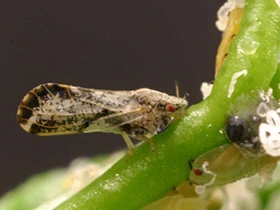

Photo: The psyllid, discovered eight years ago in Florida citrus groves, has been problematic for researchers and farmers alike. University of California, Davis/AP.
With its pleasant climate, Florida has become home to more exotic and invasive species of plants and animals than any other state in the continental U.S. Some invasive species have been brought in deliberately, such as the Burmese python or the Cuban brown snail. But the majority of species are imported inadvertently as cargo.
Amanda Hodges, who heads the biosecurity research lab at the University of Florida, says that until recently, scientists saw about a dozen new bugs arrive in Florida each year.
"But we've seen in the last few years, we've actually seen an increase in the number of new introductions," Hodges says. "We've seen more like 24 new arthropods."
These new bugs are being studied inside the biosecurity lab. After signing in and putting on a lab coat — measures designed to make sure the invasive pests being studied don't escape — you would find graduate student Ashley Poplin. She's studying one of the newest threats to American agriculture: .
"These are the little guys. They kind of have an orange abdomen and black markings," she says. "It almost looks like a black spider, but of course this has six legs instead of eight."
The bug was first discovered in Allentown, Pa., but has now spread nationwide. In Florida, it threatens vegetable crops and the state's ornamental plant industry. With time, researchers are confident they'll identify natural predators and parasites that will help them control the stink bug. It's a strategy that takes time and work, but almost always pays off.
There's one pest in Florida, however, that so far has defied the best efforts of scientists and the agriculture industry. It's a tiny bug called a , and it poses a huge threat to Florida's $9 billion a year citrus industry. The bug was only discovered eight years ago in Florida's citrus groves, says Marjorie Hoy, an entomology professor at the University of Florida. Since the discovery of the psyllid, Hoy says, Florida lost a good portion of its crops.
"It's been a disaster since then," she says. "From 860,000 acres, I think we're down to roughly 600,000 acres or less."
For decades, Hoy and other researchers used parasites and predators to successfully combat a series of invasions by bugs that preyed on citrus trees. But with this latest invasion, entomologists may have met their match. The psyllid, combined with bacteria it carries, causes , a disease that kills orange trees and makes the fruit unusable.
To combat it, citrus growers have turned away from biological controls and are using pesticides and nutrient sprays. For Hoy, it's been disheartening.
"It's a very sad situation because Florida citrus was one of those premier examples of how to grow citrus with the least number of pesticides," Hoy says. "It's just heartbreaking."
The citrus industry is reeling from greening, not just in Florida, but also in California and Brazil. Meanwhile, researchers are scrambling to develop better traps, stronger trees and possibly even transgenic solutions. Scientists are studying ways to alter the genome of citrus to make it more resistant to greening.
Latest from Produce Grower
- Fresh Express releases four new Chopped Salad Kits
- Orbia Netafim releases AI-powered Dosing 5G product range for precision fertigation
- Village Fresh Greenhouse Grown appoints Helen Aquino vice president of innovation
- Resource Innovation Institute and North Dakota State University explore co-location of data center and greenhouses
- When CapEx kills the farm
- Rethinking competition
- The National Association of State Departments of Agriculture sets 2026 federal policy focus
- 3 takeaways from Indoor Ag-Con’s ‘The State of CEA Finance’ keynote panel