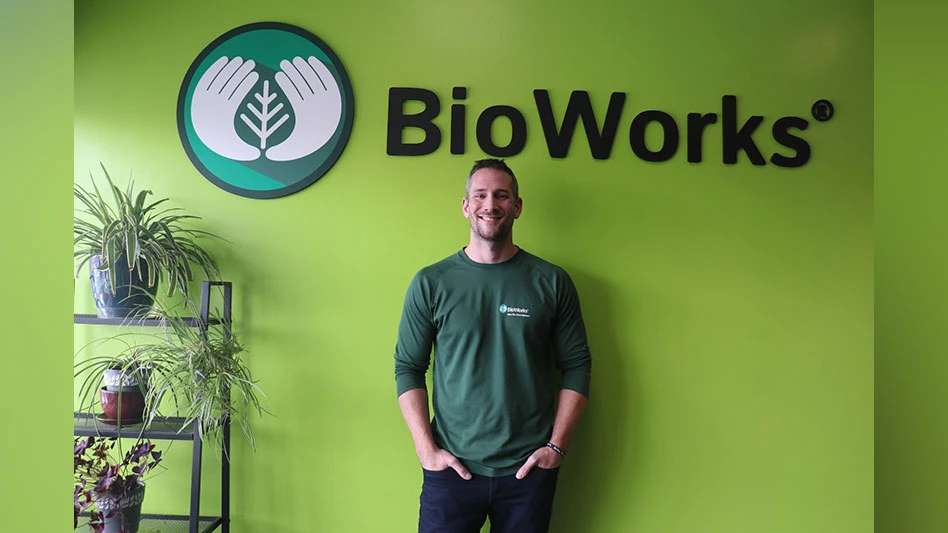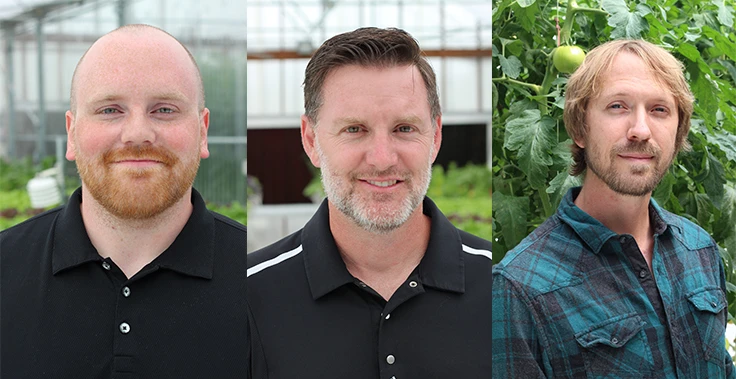
From left: Zack Foust, John Guenther and Matthew Kispert
Bringing diverse backgrounds and a wide range of skills to CropKing, the company’s new hires – Zack Foust, John Guenther and Matthew Kispert – discuss their new roles with Greenhouse Management and Produce Grower audiences.

Zack Foust, commercial sales
Hired in June, Zack Foust has stepped into a commercial sales role with CropKing, taking both phone and online orders.
In May, Foust graduated from Ohio State University with a master’s degree in plant health management, which he describes as “a combination of horticulture, entomology, pathology and statistics.” In 2015, he received a bachelor’s in plant pathology from Ohio State. His work experience involves working in research for both a chemical and a lawn care company.
CropKing sells to and consults primarily with tomato and lettuce growers, but is increasingly catering to hops and cannabis growers, Foust says. “We’ve got people all throughout the U.S., as well as some in Canada, some in the Caribbean, a few in Europe. Actually, I’m talking to a guy now – he went to one of our workshops and his idea is to start a greenhouse over in Africa.”
As far as greenhouse products are concerned, Foust says he can cater to growers who have questions about structures, such as gutter-connects, hoop houses and high tunnels; growing systems, such as NFT and bato bucket systems; and fertilizers, such as micronutrient recipes that are tailored to irrigation water.
“If they already have a greenhouse, I can answer questions about what would be suitable to their environment depending on their location and what kind of greenhouse they have,” he says. “Some of the customers we get like to retrofit, so if they want to install one of our systems into their current greenhouses, we’ll answer a lot of questions about that.”
Foust says he enjoys how CropKing appeals to hobbyists as well as commercial growers. He also appreciates CropKing’s focus on beneficial insects and biopesticides versus synthetic chemistries. “Not to mention, as far as pollination goes, we love bees,” he says. “Bees are great. We try to shy away from the chemical pest control as often as possible.”

John Guenther, commercial sales
Since October, commercial sales representative John Guenther has been assisting produce, cannabis and hops growers. Many of his clients are commercial growers with large-scale facilities.
Previously, Guenther worked at a nonprofit with a behavioral health focus, where he coached troubled adolescents and helped them to develop job skills through horticulture therapy. “I actually utilized CropKing’s systems in the therapies that I utilized, and when I interacted with clients,” he says. “We did greenhouse management, hydroponics and aquaponics. We raised tilapia, in addition to growing lettuce and tomatoes.” Guenther still volunteers at the nonprofit where he previously worked, ensuring adolescents receive the help and assistance they deserve.
How does horticulture therapy work, exactly? “It’s getting the kids down in the dirt, getting them active, [nurturing] something, [learning] how to grow, how to take care of it – they take ownership of what they’re doing,” Guenther says. “And if they don’t take care of it, the plant dies, and then we get to talk about how you need to nurture and you need to take care of this in order for it to grow, and we can kind of relate that right back to their own life choices and their decision-making.”
One day in his old job, Guenther was looking online for supplies for his CropKing systems, and came across employment opportunities. He applied, and within a couple days, COO Marilyn Brentlinger called him back.
Guenther was already familiar with many of CropKing’s numerous systems, so some closely relate back to his past. For instance, CropKing sells two types of aquaponics systems – one with a plant tray where the fish waste filters into the plant, and another without a plant tray. “We sell a lot of those to educational entities, nonprofits,” he says. Other items in CropKing’s inventory, such as animal fodder, cater more toward dairy and meat farmers.
CropKing offers a lifetime of support with every product, and its representatives are available by both phone and email, Guenther says. “That’s the thing with CropKing is that in the 30-plus years we’ve been in business, there isn’t much that we haven’t seen with growers and with issues,” he says. “So that’s kind of our niche, that we sell a system, and we offer unparalleled support for that system, in every aspect from setup to propagation, harvesting, even to marketing – every facet of a grow operation.”

Matthew Kispert, horticulturist
Hired onto the CropKing team as a horticulturist this past April, Matthew Kispert originally hails from the Chicagoland, Ill., area. He holds a master’s degree in horticulture from the University of Minnesota, and a bachelor’s degree in biology with a chemistry minor from the University of Illinois. For three years before coming to CropKing, he ran a greenhouse in Iowa.
When asked why he wanted to work for CropKing, Kispert says, “I’ve always kind of had a passion for greenhouse vegetables and growing, and CropKing is a pretty well-known name in the industry,” he says. “It just seemed like a good fit. Now that I’m out here and meeting everybody – it’s a smaller company from where I came from, and the smaller company attitude is really awesome.”
So far in his new role, Kispert says he assists the support team, helps customers with issues and makes occasional site visits to growers. Additionally, he works with the demonstration unit, tests products and gives presentations in the controlled environment agriculture (CEA) classes that CropKing organizes. Kispert says he is also helping develop a weeklong internship program, which will be longer and more hands-on than the company’s CEA class.
Another project that Kispert is working on is a partnership with Ohio State University that examines how human pathogens behave in nutrient film technique (NFT) systems compared to in row production. While it’s a completely different environment, Ohio State is looking at possible commonalities between the two production types, and what steps to take to remediate the contamination event, he says. “CropKing is giving them some support with that,” Kispert says. “We supplied the equipment and I’m going to be the tech support for the equipment and work with the two researchers there.”
Photos courtesy of CropKing
Latest from Produce Grower
- The Growth Industry Episode 10: State of the Horticulture Industry
- Bimi Baby Broccoli partners with Cal-Organic Farms
- Millennium Pacific Greenhouses launches California Grown Cucumber Program
- Scientists develop vitamin A-enriched tomato to fight global deficiency
- UTIA and UT Knoxville research teams will develop automated compost monitoring system
- [WATCH] Advances in growing media for CEA production
- [WATCH] Taking root: The green industry’s guide to successful internships
- Award winners announced for 2026 PHS Philadelphia Flower Show