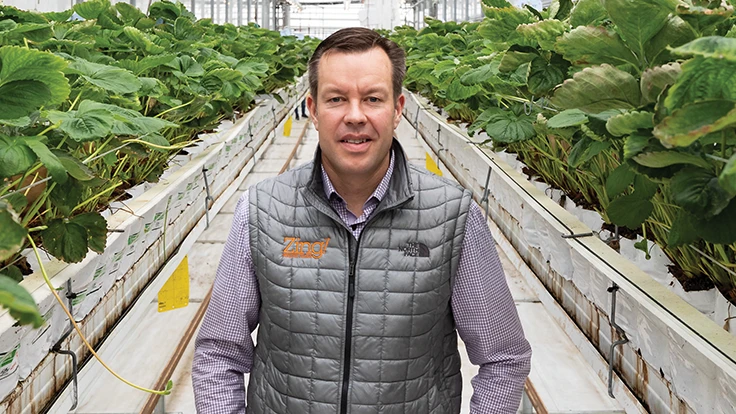
Photo: Chad Barry
In August, Mucci Farms acquired a controlling interest in Orangeline Farms, another grower based in Leamington, Ontario, Canada. Founded in 2000, Orangeline was perhaps best known for its greenhouse pepper production, as well as its Zing! Healthy Foods brand.
“It’s an exciting time for the company as we continue our aggressive expansion plans to increase our local and regional production,” said CEO Bert Mucci, per a press release. “The Orangeline acquisition comes with a 32-acre greenhouse and a warehouse with additional land totaling 100 acres. Consumers are demanding more local production, and we’re listening. We also have plans in place to build on the additional land that was received as part of the agreement.”
Below, Orangline founder Duffy Kniaziew, who will retain the remaining ownership of Orangeline, discusses why he made the deal, what problems it helps the company solve and more.
Produce Grower: How did this deal come together and how long has it been in progress?
Duffy Kniaziew: I think it was a fairly lengthy process that started as a search for growth organically within Orangline of how we address customer concerns, how we address employee's concerns and how we continue to build our brand. So, that was one grouping and a second grouping is that Orangeline has had a culture of innovation for a number of years and out of that innovation come the need to implement it. In today's world, the cost associated with innovation is fairly extreme, so looking to capitalize on that innovation, partnering with a much larger player made a lot of sense.
PG: What, to you, is it about innovation that makes it so expensive right now?
DK: The biggest thing around being a greenhouse in Canada is around lit production and the ability to produce Ontario products in the dead of winter. The lighting cost is intensive, as well as the ability to secure the necessary hydro to drive the lights.
PG: What about Mucci Farms makes them the right partner? They have a controlling stake now, which I’m sure offers some financial security, but what about them is attractive to you?
DK: I am a first-generation farmer and I've been [on] the growing side of things for more than 20 years now. And for us, it was important to partner with someone who has a strong team in place and has a lot of depth and wealth of information on the growing side. When we looked at Mucci, they go back generations upon generations with greenhouse growing and are certainly one of the forerunners on being able to execute in the greenhouse who also happen to market well. That, to us, was an important link as opposed to some other industry leaders that are very strong in marketing first and have had to reverse engineer the growing side.
PG: With this agreement, they take a controlling stake and are doing some more expansion, but what does it mean for Orangeline in the short term?
DK: It adds strength to the brand in terms of marketing as well as cost efficiencies. Orangeline was at an interesting place — we were literally too big to be small, but far too small to be big. In a world where efficiencies and margins matter, that becomes an uncomfortable place at times. For us, it certainly provides better access to product and allows us to do a better job for our customers. Related story: Some growers, including Ontario-based Orangeline Farms, are growing strawberries indoors to better cater to consumers’ interest in the crop.
PG: How does the product angle of this — what you actually grow — factor into this?
DK: I think it comes back to the innovation side and us being largely a pepper grower. It certainly strengthens Mucci's bench when it comes to the pepper side of operations. And for us, it allows us to capitalize on some of our innovation.
It's a heavy focus on peppers. In terms of strawberries, the Mucci portfolio has a dedicated facility for strawberries, so to have the Orangeline facility grow strawberries really becomes inefficient use of the operation. While some of the knowledge and some of the IP will move over, Orangeline, for the near future, will be focused on peppers.
PG: Can you speak more to the marketing side of this - this doesn't mean Orangline's Zing! Healthy Foods brand goes away, correct?
DK: No — that's an important part of this deal. The intention is for that [brand] to live on and have more horsepower behind it.
There's no question that this will help us get into more stores. But more importantly, if we take a macro view at it, some consolidation in greenhouse marketing is likely a very good idea in that we are essentially competing for the same customers. Any grower in Leamington, regardless of their marketing, is ultimately competing for the same end user at retail, the consumer who is buying tomatoes, cucumbers or peppers or whatever. We are ultimately trying to give them the best experience possible so they become repeat customers. Maybe as an industry we're a little bit top heavy on marketers - there are too many businesses competing for that exact same shelf space where some consolidation might be a good thing for everybody.
PG: When they took controlling interest, was that for you a sticking point or a concern of yours at all?
DK: There's no question it's a thought point, it's something that, in this scenario, that I personally had to wrap my head around. But when I look at how this impacts others, once it gets outside of me personally, it's something where there's certainly more benefit, I believe. We believe in the company we've partnered with, so it's something I'm comfortable with.
PG: How long did it take you to decide that this was the right move? DK: I think there's probably two points to that, the first being that I believe that, as a business grows and matures and the world ebbs and flows, it means there's a responsibility for the business owner to keep your eyes wide open and look at what's happening within an industry and take that into consideration as you do your strategic planning and as you look forward. That's been going on for quite a while as we look at next steps. In the past, growth was pretty straightforward — build 10 acres, see how quickly we can expand, add five more, add five more, add another 12 and so on. But at some point, that's not really the point anymore — it's how can we as a business grow strategically and be smart in how we go forward.
In terms of wrapping our heads around what ultimately became the partnership, that took the better part of several months.
Latest from Produce Grower
- The Growth Industry Episode 10: State of the Horticulture Industry
- Bimi Baby Broccoli partners with Cal-Organic Farms
- Millennium Pacific Greenhouses launches California Grown Cucumber Program
- Scientists develop vitamin A-enriched tomato to fight global deficiency
- UTIA and UT Knoxville research teams will develop automated compost monitoring system
- [WATCH] Advances in growing media for CEA production
- [WATCH] Taking root: The green industry’s guide to successful internships
- Award winners announced for 2026 PHS Philadelphia Flower Show