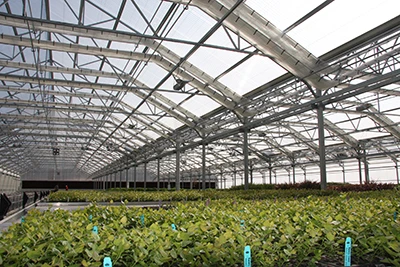
In 2007 and 2008 there weren’t many businesses doing well. Among those suffering in the harsh economicconditions of the time was Florida-based AgriStarts, a young plant company in Apopka. The company inherited about $1 million of debt after the closing of a franchise and was at a crossroads.
That’s when they decided to ramp up their production and develop an edibles program.
AgriStarts was founded nearly 30 years ago, starting primarily as a distributor of tissue cultures, seeds and cuttings for local tropical growers. But even in those early stages, the company dabbled in edibles, selling bananas for their ornamental qualities. Over time, the company started catering to more individual customers’ needs.
“We had been doing kiwi for one customer in California for 20 years, bananas and pineapple for 25 years for another, but we didn’t consider an edibles program then,” Randy Strode, president of AgriStarts says.
Then, roughly 12 years ago, the company added University of Florida blueberries to the mix. That was when they decided they officially had an edibles program. Then the American economy went through a prolonged period of recession and nearly every market took a hit, including horticulture.
One of the franchises Strode had started years before went under, and AgriStarts inherited the debt. At the same time, the company’s blueberry program was rapidly expanding. So the company made a decision. It would use the now empty franchise location as a house for an expanded edibles program.
“We’ve basically doubled our size in the past 10 years and it’s because of increased sales of papaya and bananas and edibles overall,” Strode says.
As the company ramped up their edibles program, they quickly discovered they weren’t growing at peak efficiency. Edibles have very different light needs than tropicals. So, about four years ago, the company brought in additional lights but they still weren’t getting the desired product.
“We added 30,000 square feet of Nexus Greenhouse. It has all the bells and whistles, shades, lights, all the automation you could possibly want and we filled it up with edibles. And we added 20,000 square feet of outdoor production to harden off plants that will be going straight to outdoor production,” he says.
As the market for edibles evolves, AgriStarts continues to look for new niches to explore and capitalize on. Some of its more popular crops are now rare plants that are difficult to find in the United States.
“We’ve been doing more katuk and pandanas. We really try to listen to our customers and fulfill their desires,” he says.
Latest from Produce Grower
- The Growth Industry Episode 10: State of the Horticulture Industry
- Bimi Baby Broccoli partners with Cal-Organic Farms
- Millennium Pacific Greenhouses launches California Grown Cucumber Program
- Scientists develop vitamin A-enriched tomato to fight global deficiency
- UTIA and UT Knoxville research teams will develop automated compost monitoring system
- [WATCH] Advances in growing media for CEA production
- [WATCH] Taking root: The green industry’s guide to successful internships
- Award winners announced for 2026 PHS Philadelphia Flower Show