.jpg)
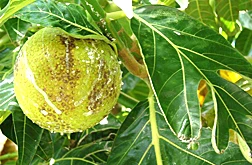
Photo courtesy of Forest and Kim Starr, Starr Environmental, Bugwood.org.
Breadfruit, used as a folk remedy in Pacific regions to control insects, is an effective mosquito repellent, U.S. Department of Agriculture (USDA) scientists have found.
Agricultural Research Service (ARS) scientists and their collaborators at the University of British Columbia in Okanagan, Canada, identified three breadfruit compounds—capric, undecanoic and lauric acids—that act as insect repellents. ARS is the chief intramural scientific research agency of USDA.
In the study, chemist Charles Cantrell and his colleagues at the ARS Natural Products Utilization Research Unit (NPURU) in Oxford, Miss., and the University of British Columbia scientists collected smoke extracts by burning sun-dried clusters of flowers in the traditional method used by people in Pacific regions.
Capric, undecanoic and lauric acids, which are saturated fatty acids, were found to be significantly more effective at repelling mosquitoes than DEET, the primary insect repellent used against biting insects. For the first time, breadfruit was shown to actually work as a repellent, confirming it as a valid folk remedy, according to Cantrell.
Click here to read more.
Latest from Produce Grower
- The Growth Industry Episode 10: State of the Horticulture Industry
- Bimi Baby Broccoli partners with Cal-Organic Farms
- Millennium Pacific Greenhouses launches California Grown Cucumber Program
- Scientists develop vitamin A-enriched tomato to fight global deficiency
- UTIA and UT Knoxville research teams will develop automated compost monitoring system
- [WATCH] Advances in growing media for CEA production
- [WATCH] Taking root: The green industry’s guide to successful internships
- Award winners announced for 2026 PHS Philadelphia Flower Show