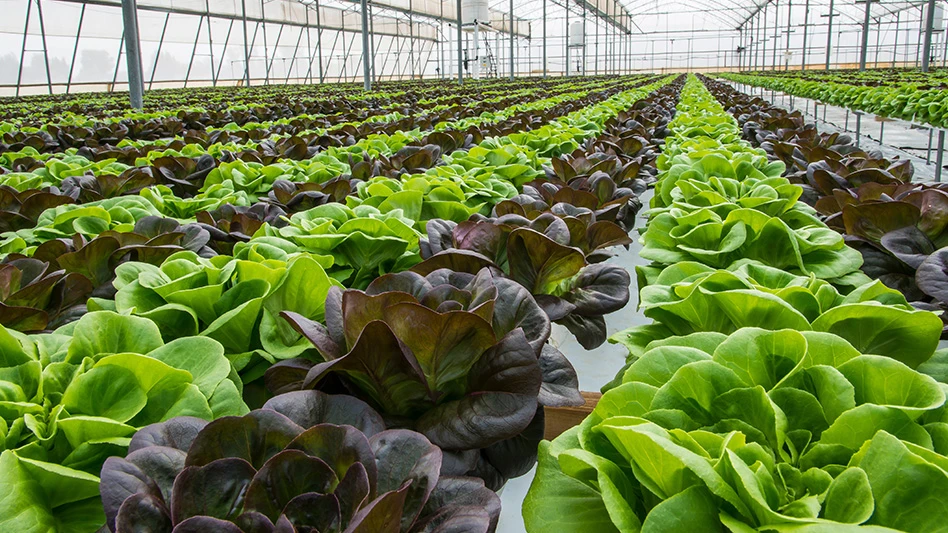
Next time you buy a Texas tomato, check where it was grown. The answer might surprise you. That’s because 90 percent of the state’s tomatoes come from a few greenhouses in the arid deserts of Far West Texas.
"The way this works is, we don’t grow in the soil. We grow in a sterile environment, like coco peat,” says Doug Kling, senior vice president for Village Farms, which owns and operates the greenhouse. “There’s no hard minerals in that, like arsenic. So what we do is, we control the environment by controlling the airflow in the greenhouse, closing the vents off, misting from the top to makes sure it’s humid enough so the plants don’t dry out.”
The plants are “infused” in water in the coco peat, and any runoff is captured in a gutter underneath. “We recycle that up to five times,” Kling says, “which allows us to use 87 percent less water than in the field.” That water is then sent to the city golf course. “And because of the ultimate climate conditions,” Kling adds, “we get thirty times the yield of a [traditional] field per acre.”
Click here to read more.
Latest from Produce Grower
- The Growth Industry Episode 10: State of the Horticulture Industry
- Bimi Baby Broccoli partners with Cal-Organic Farms
- Millennium Pacific Greenhouses launches California Grown Cucumber Program
- Scientists develop vitamin A-enriched tomato to fight global deficiency
- UTIA and UT Knoxville research teams will develop automated compost monitoring system
- [WATCH] Advances in growing media for CEA production
- [WATCH] Taking root: The green industry’s guide to successful internships
- Award winners announced for 2026 PHS Philadelphia Flower Show