Photo courtesy of Tyler Jones, UF/IFAS photography.
University of Florida scientists have developed a tomato packed with significantly higher levels of vitamin A, a breakthrough that could help combat one of the world’s most widespread nutritional deficiencies.
In newly published research by Jingwei Fu, Denise Tieman and Bala Rathinasabapathi from UF’s Institute of Food and Agricultural Sciences, the researchers introduce fortified tomatoes with boosted beta-carotene — the compound the body converts to vitamin A.

horticultural sciences at UF/IFAS and
the author of the new study.
“The levels of beta-carotene found in the improved tomatoes are more than those found in market tomatoes and in many beta-carotene-rich foods like kale and sweet potatoes,” said Rathinasabapathi, professor of horticultural sciences at UF/IFAS.
Vitamin A deficiency, which impairs growth, red blood cell production, immunity and eyesight, affects 345 million people across 79 countries. Children and pregnant women in impoverished societies are particularly vulnerable. Daily consumption of 50 to 100 grams of these tomatoes can efficiently address vitamin A deficiency, Rathinasabapathi said.
The researchers chose the tomato because it’s one of the world’s most popular vegetables, with annual production of 180 million tons worldwide.
Fu, who conducted the research as a doctoral student under Rathinasabapathi’s direction in the UF/IFAS College of Agricultural and Life Sciences — and is now a post-doctoral assistant in the same lab — introduced CCS, a gene from the carotenoid synthetic pathway from peppers, into tomatoes to increase beta-carotene.
Their research showed that the pepper gene worked to improve tomatoes’ nutritional value when it was transferred to different varieties of tomatoes.
To understand the function of a gene in peppers, scientists first turned off CCS, a gene involved in the synthesis of capsanthin and capsorubin, two pigments in red peppers.
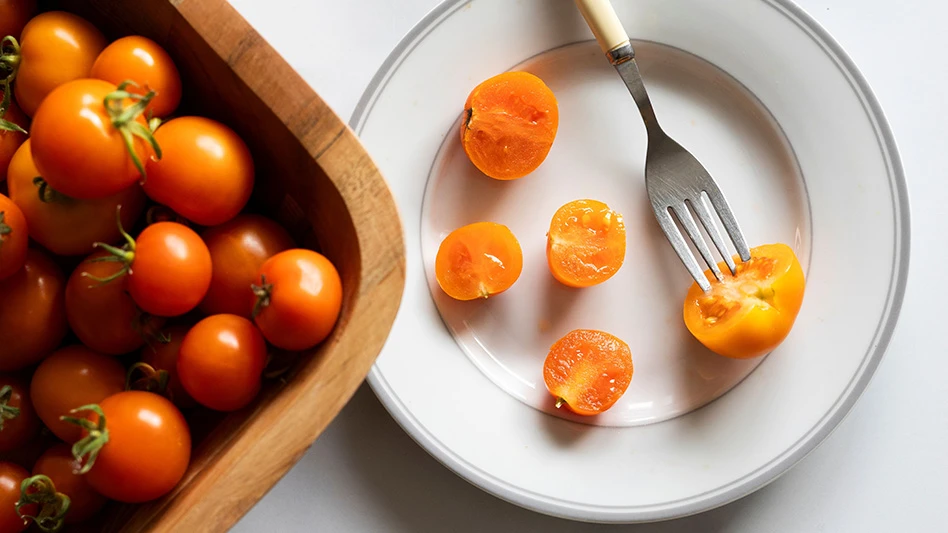
“The pigments are good for people because they are excellent antioxidants, like the color you see in sweet potatoes or carrots,” Rathinasabapathi said. “After identifying the gene from that experiment, we expressed it in a tomato variety. The resulting plant had orange tomatoes instead of red. The improved tomato had increased levels of pigments capsanthin, capsorubin and beta-carotene. This made the new tomato nutritionally valuable.”
In the next part of the study, researchers developed hybrid tomatoes by crossing selected varieties and the newly developed orange tomato. The resulting hybrids were nutritionally much more valuable in terms of beta-carotene, capsanthin and capsorubin levels than the originally developed tomato.
The fruit of these hybrids are also larger than the original varieties. In controlled experiments, the orange tomato yielded more fruit and had improved flavor volatile profiles when compared to fruit of unmodified controls. Beta-carotene, the orange pigment known in vegetables and fruits, is a provitamin A, which means the body converts it into vitamin A, Rathinasabapathi said.
“In general, tomatoes accumulate lycopene — the red pigment — but not high levels of beta-carotene,” he said. “We can confidently say our improved tomatoes are nutritionally more valuable than commercially available tomatoes and some of the food material known for beta-carotene, such as carrots and kale.”
Latest from Produce Grower
- The Growth Industry Episode 10: State of the Horticulture Industry
- Bimi Baby Broccoli partners with Cal-Organic Farms
- Millennium Pacific Greenhouses launches California Grown Cucumber Program
- UTIA and UT Knoxville research teams will develop automated compost monitoring system
- [WATCH] Advances in growing media for CEA production
- [WATCH] Taking root: The green industry’s guide to successful internships
- Award winners announced for 2026 PHS Philadelphia Flower Show
- U.S. horticulture operations report $18.3 billion in sales: USDA